Improving Attention and Communication Skills Through Applied Behavior Analysis

Improving Attention and Communication Skills Through Applied Behavior Analysis
Every child possesses a unique way of interacting with the world, processing information, and expressing their thoughts. For many families, watching a child struggle to focus on a task or find the right words to share their experiences can be challenging. Early childhood development relies heavily on two foundational pillars: the ability to sustain attention and the ability to communicate effectively. When these skills require extra support, structured and compassionate intervention can make a profound difference.
Applied Behavior Analysis, widely known as ABA therapy, offers a systematic, evidence based framework designed to nurture these essential capabilities. By breaking down complex behaviors into smaller, manageable steps, this approach helps young learners navigate social environments, express their needs, and engage more deeply with their surroundings. For families seeking dedicated support, exploring ABA therapy for kids Dubai provides access to tailored programs that honor each child’s individuality while fostering meaningful progress.
Understanding The Core Of Applied Behavior Analysis
At its heart, Applied Behavior Analysis is the science of learning and behavior. It is not a rigid, one size fits all system. Instead, it is a flexible, highly individualized approach that looks at how behavior changes based on the environment. By understanding the relationship between what happens before a behavior occurs and what happens immediately after, specialists can design interventions that encourage positive, functional skills while gently reducing behaviors that may hinder learning.
For young children, learning is most effective when it feels natural, engaging, and rewarding. Modern applications of this science prioritize positive reinforcement. This means celebrating successes, no matter how small, to build confidence and motivation. When a child realizes that their efforts lead to positive outcomes, they are naturally driven to repeat those beneficial behaviors, paving the way for long term development.
The Role Of Attention In Early Learning
Attention is more than just sitting still or making eye contact. It is the gatekeeper of all learning. Before a child can learn to write their name, follow a multi step instruction, or play a game with a peer, they must first be able to attend to the relevant information in their environment.
In early childhood, attention manifests in several ways:
- Sustained Attention: The ability to focus on a single activity or stimulus for an extended period, such as listening to a story or completing a puzzle.
- Selective Attention: The capability to focus on important information while filtering out distractions, like tuning into a teacher’s voice in a bustling classroom.
- Joint Attention: A crucial social milestone where two individuals share focus on the same object or event, such as a child looking at a toy and then looking at their parent to share the joy.
When a child faces difficulties with attention, the world can feel overwhelming. Sensory inputs can blend together, making it hard to discern what requires focus. Through structured intervention, children learn how to manage these inputs, gradually increasing their capacity to concentrate and engage.
Nurturing and Expressing Receptive Language
How Intervention Strategies Build Focusing Skills
Building attention is a gradual process that requires patience, consistency, and a deep understanding of a child’s current capabilities. Behavior analysts use several proven strategies to help children expand their attention spans and improve their focus.
Breaking Tasks Into Smaller Steps
A large, complex task can feel daunting to a young child, often leading to frustration or withdrawal. By utilizing task analysis, specialists break down an activity into its smallest components. For instance, instead of asking a child to clean up their play area all at once, the task is divided into individual steps: pick up the red block, place it in the bin, then pick up the blue car. Each successful step is met with encouragement, making the overall objective achievable and less intimidating.
Utilizing Visual Supports
Visual aids serve as powerful tools for enhancing focus and predictability. Schedules using pictures, visual timers, and clearly defined workspaces help children understand what is expected of them and what will happen next. When a child can see a clear path forward, their anxiety decreases, allowing their mind to settle and focus on the task at hand.
Systematic Reinforcement
Positive reinforcement is dynamically paired with attention building exercises. Initially, a child might receive praise or a small reward for focusing on a task for just thirty seconds. As their ability grows, the duration required for reinforcement is gradually increased. This systematic progression ensures that the child is always challenged just enough to grow, but not so much that they become discouraged.
Unlocking The Power Of Communication
Communication is the tool through which we connect with the world, express our choices, and build relationships. When a child struggles to communicate verbally or non verbally, it can lead to intense frustration, which sometimes manifests as challenging behavior. Therefore, prioritizing communication skills is a central objective of any comprehensive behavior program.
Effective communication involves both receptive language, which is the ability to understand what others are saying, and expressive language, which is the ability to convey one’s own thoughts and desires. A balanced approach addresses both sides of this coin, ensuring that children can both navigate their social world and make their voices heard.
Nurturing Expressive And Receptive Language
To build robust communication pathways, intervention programs focus on practical, functional language skills that children can use immediately in their daily lives.
Functional Communication Training
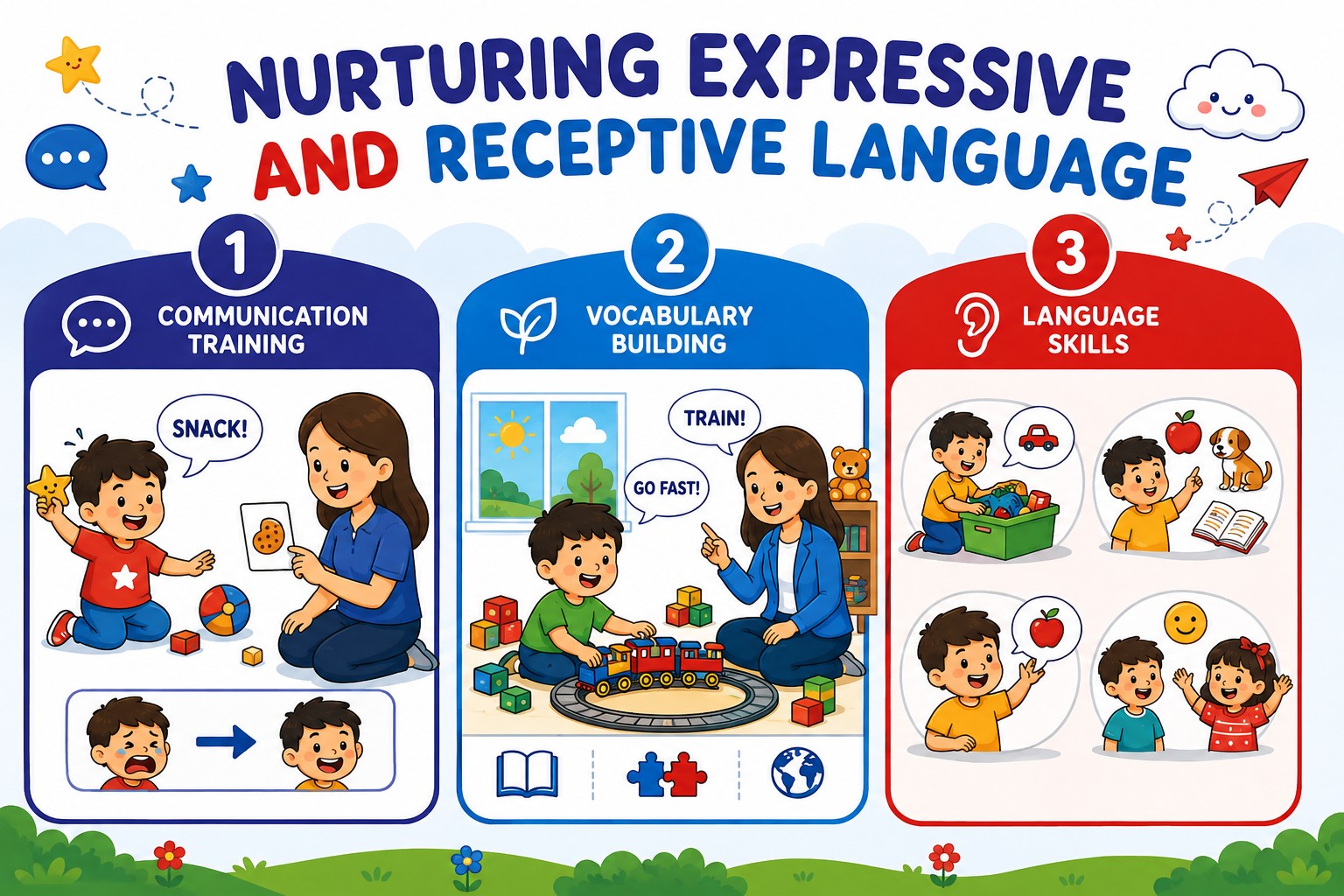
One of the most impactful strategies used in modern behavioral support is Functional Communication Training. This method identifies the underlying reason behind a specific behavior, such as a child throwing a toy because they want a snack, and replaces that behavior with an appropriate communication alternative. The child might be taught to use a specific word, point to a picture, or use a gesture to request the snack. When the child learns that using words or symbols gets their needs met much faster than a tantrum, the functional communication naturally replaces the challenging behavior.
Expanding Vocabulary Through Natural Environment Teaching
While structured, table top exercises have their place, learning often thrives in the natural environment. Natural Environment Teaching takes advantage of a child’s current interests and motivations. If a child is drawn to a toy train, the specialist utilizes that moment to encourage language. They might model words like train, track, fast, or stop, encouraging the child to imitate or use the words to continue playing. This ensures that language learning is contextual, meaningful, and deeply connected to real world experiences.
Developing Receptive Language Skills
Understanding language is just as critical as producing it. Children are guided through activities that strengthen their ability to follow directions, identify objects, and comprehend social cues. By building these foundational receptive skills, children become more receptive to learning in traditional school environments and can interact more fluidly with family members and peers.
Nurturing and Expressing Receptive Language
The Intersection Of Attention And Communication
Attention and communication are not isolated skills; they are deeply intertwined. A child cannot easily learn to communicate if they cannot focus on the person speaking to them, or attend to the visual cues and gestures that accompany speech. Conversely, a child who can communicate effectively is better equipped to ask for help when a task becomes too challenging, allowing them to maintain their focus rather than giving up.
Joint attention represents the perfect intersection of these two areas. When a child looks at a bubble wand, looks at their teacher, and points, they are demonstrating a sophisticated mix of shared focus and expressive intent. By targeting both attention and communication simultaneously, ABA therapy creates a synergistic effect, accelerating a child’s overall developmental progress.
The Power Of Early Intervention
While progress can be achieved at any stage of life, the early years of a child’s development present a unique window of opportunity. During early childhood, the brain is remarkably adaptable, a characteristic known as neuroplasticity. This means that neural pathways are still forming, and positive behaviors and learning habits can be established more deeply.
Introducing structured support early can fundamentally alter a child’s developmental trajectory. By addressing attention gaps and communication delays before they become more pronounced, children gain the tools they need to transition more smoothly into school environments, build friendships, and achieve greater independence.
Tailoring Support For Families In Dubai
Every community has its own unique landscape, and families navigating early childhood support benefit greatly from localized, accessible care. For parents exploring options, seeking specialized ABA therapy for kids Dubai means finding professionals who understand the diverse, multicultural environment of the region.
A high quality local program offers several distinct advantages:
- Cultural Sensitivity: Understanding that families come from varied backgrounds and honoring those values within the learning program.
- School Integration: Working closely with local nurseries and schools to ensure that the skills a child learns in therapy transfer successfully to the classroom.
- Community Connection: Providing parents with a network of local resources and support groups, ensuring they never feel alone on their journey.
By choosing a dedicated local partner, families ensure that their child receives consistent, integrated care that fits seamlessly into their daily lives in the city.
Collaborating With Families For Long Term Success
A child’s progress is never limited to the hours spent with a specialist. True, lasting transformation happens when the strategies used during intervention are woven into the fabric of daily home life. This is why parent collaboration and training are essential components of any successful program.
Specialists work hand in hand with parents, sharing insights, modeling techniques, and helping families turn everyday routines into opportunities for learning. Whether it is practicing patience during mealtime, using visual schedules before bed, or encouraging language during a trip to the park, parents become empowered to guide their child’s growth confidently. This unified approach creates a supportive, predictable environment where the child can thrive.
Looking Forward To A Brighter Future
Watching a child overcome challenges, find their voice, and engage more fully with the world is a profoundly rewarding experience. Through the structured, empathetic application of behavior science, children learn that they are capable of focus, connection, and growth.
Every milestone achieved, whether it is a few extra minutes of quiet concentration, a newly spoken word, or a shared moment of laughter, is a step toward a more independent and fulfilling future. With the right support, tailored guidance, and a compassionate team by your side, the path ahead becomes clearer, brighter, and filled with infinite possibilities for your child’s development.
