Myofunctional Therapy for Adults: It’s Never Too Late to Retrain Your Muscles

Myofunctional Therapy for Adults: It’s Never Too Late to Retrain Your Muscles
When thinking about physical fitness, most people focus on their core, legs, or back. However, the head, neck, and mouth contain a complex group of muscles that play a central role in daily health and well-being. These facial and oral muscles govern how a person breathes, chews, swallows, and rests their jaw. When these muscles do not function in harmony, it can lead to a quiet chain reaction of subtle health issues, ranging from disrupted sleep and persistent jaw tension to chronic mouth breathing and altered facial posture.
For many years, muscle re-education in the oral region was viewed as a treatment intended primarily for children. Parents were advised to seek support for youngsters who struggled with prolonged thumb sucking, tongue thrusting during swallowing, or open-mouth resting habits. Modern research and clinical practice show that muscle adaptability does not end with childhood. The human brain and neuromuscular system maintain an extraordinary capacity to adapt, learn, and rebuild movement patterns throughout adulthood.
Understanding how adult muscle retraining works opens up new avenues for improving everyday comfort, airway health, and overall quality of life. For individuals seeking guidance through myofunctional therapy Dubai offers access to comprehensive care designed to restore proper oral function, regardless of age.
Understanding Oral Myofunctional Disorders in Adulthood
Oral Myofunctional Disorders involve abnormal habit patterns, altered resting postures, or functional impairments involving the tongue, lips, jaw, and soft tissues of the mouth and face. While these patterns often begin in early childhood, they frequently persist into adult life if left unaddressed.
In a healthy system at rest, the human mouth defaults to a specific physical posture. The lips stay closed without effort, breathing occurs gently through the nose, and the tongue rests flat against the roof of the mouth, positioned comfortably behind the upper front teeth. This natural resting position acts as an internal structural support system. It helps stabilize the jaw, guides optimal airway space, and maintains balanced tension across the facial muscles.
When an oral myofunctional disorder is present, this equilibrium breaks down. The tongue may lie low in the floor of the mouth, pressing against or between the teeth rather than supporting the palate. The lips may remain slightly parted, encouraging chronic mouth breathing. During swallowing, instead of sweeping backward smoothly against the roof of the mouth, the tongue may thrust forward or laterally against the teeth.
In adults, these altered patterns are rarely a matter of simple fatigue or temporary habit. Over decades, muscles adapt to incorrect patterns, turning compensatory behaviors into subconscious routines. The jaw, neck, and airway muscles continuously overwork or underperform to compensate for improper tongue placement, eventually leading to secondary physical strain.
Common Signs and Subtle Symptoms in Adult Patients
Recognizing an oral myofunctional disorder in adulthood can be challenging because symptoms often manifest as everyday physical discomforts that seem unrelated to oral posture. Many adults adapt to these issues over time, assuming that chronic jaw tightness or waking up with a dry mouth is simply a normal part of life.
Several common signs may indicate that adult oral muscles are out of balance:
- Chronic Mouth Breathing: Frequently breathing through the mouth during the day or waking up with a dry mouth, sore throat, or chapped lips in the morning.
- Persistent Jaw Discomfort: Tension, clicking, or aching in the temporomandibular joint, often caused by the facial muscles compensating for improper tongue posture.
- Tongue Thrust or Swallowing Difficulties: Pushing the tongue against or between the teeth when swallowing food, liquids, or saliva, sometimes accompanied by noisy swallowing or frequent choking on liquids.
- Restless Sleep and Snoring: Poor tongue posture during sleep allows the tongue to fall backward into the throat, narrowing the airway and contributing to heavy breathing, snoring, or fragmented sleep.
- Facial and Neck Tension: Unexplained tightness in the shoulders, neck, and facial muscles stemming from altered head posture and compensatory muscle use.
- Speech Precision Issues: Subtle difficulty pronouncing specific sounds, particularly sibilants like “s” and “z,” due to imprecise tongue tip placement.
When these symptoms linger, they create a continuous cycle of strain. Addressing the root cause requires looking beyond surface symptoms to evaluate how the muscles of the face, tongue, and throat are functioning together.
The Science of Neuromuscular Plasticity in Adults
A common concern among adult patients is whether established muscle patterns can truly be changed after decades of repetition. It is easy to assume that once the jaw and facial structures have fully developed, the way those muscles operate is permanently fixed.
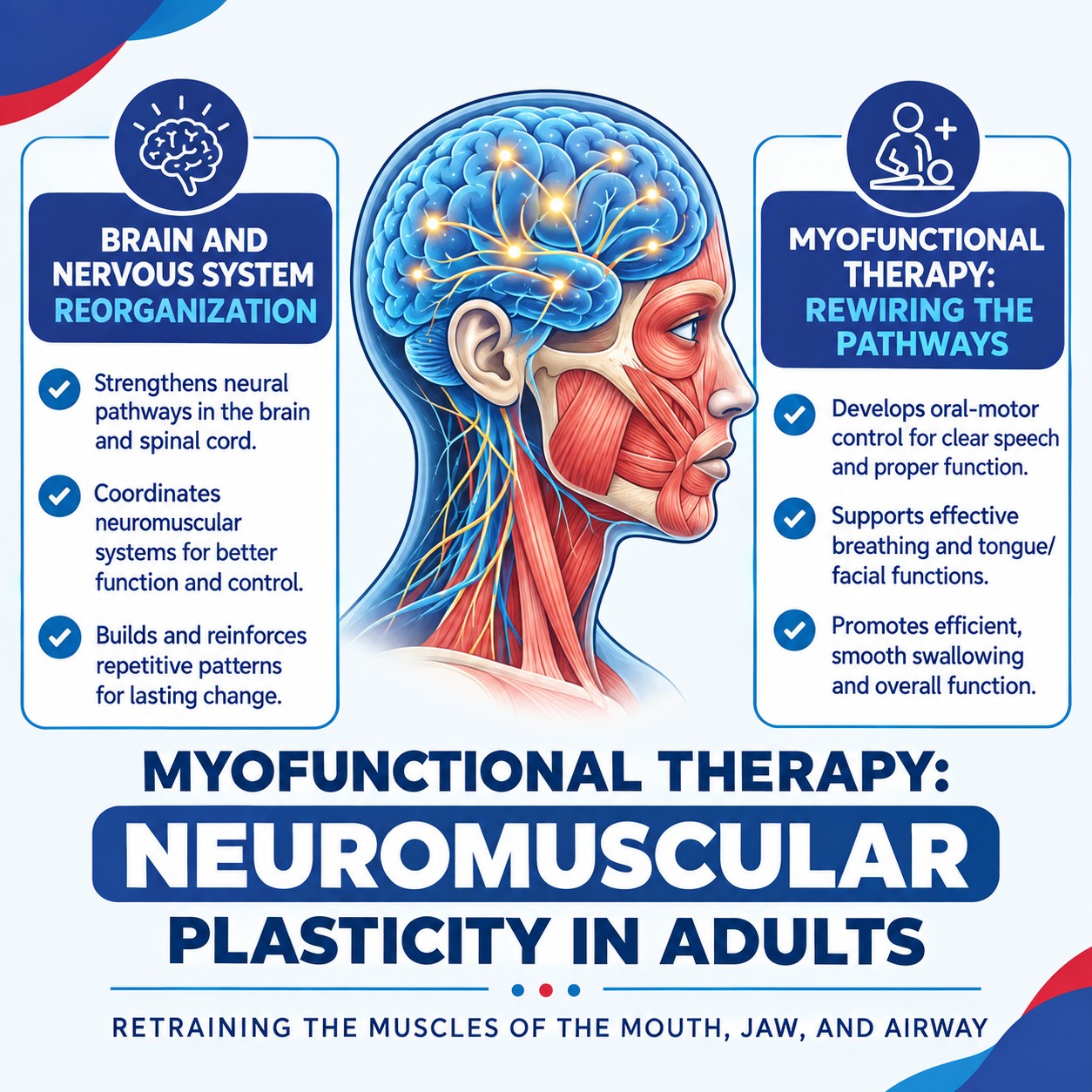
Fortunately, scientific research into neuroplasticity confirms that the human nervous system remains capable of reorganizing its neural connections throughout life. Neuroplasticity refers to the brain’s ability to learn new motor skills, adapt to new environments, and form fresh functional pathways in response to targeted practice and repetitive movement.
Just as an adult can learn a new language, refine an athletic technique, or master a musical instrument through deliberate practice, the muscles of the mouth, jaw, and airway can be retrained. Through structured, goal-oriented exercises, myofunctional therapy systematically rewires the neural pathways that control oral resting posture and swallowing reflexes.
When an individual consciously practices targeted tongue, lip, and swallowing movements, the brain creates new motor maps. Over time, these conscious exercises transform into effortless, automatic habits. The tongue begins to find its proper resting place on the roof of the mouth naturally, nasal breathing becomes the default mode, and swallowing occurs smoothly without exerting unnecessary strain on the surrounding facial muscles.
Core Objectives of Myofunctional Therapy
Myofunctional therapy is an individualized, exercise-based program designed to evaluate, retrain, and stabilize the muscles of the face, tongue, mouth, and neck. Rather than focusing on a single symptom, the therapeutic process focuses on establishing four fundamental physical milestones:
Establishing Consistent Nasal Breathing
The human respiratory system is designed for nasal breathing. The nose filters incoming air, humidifies it, and warms it to body temperature before it enters the lungs. Nasal breathing also promotes optimal oxygen exchange and stimulates the production of nitric oxide, a compound that expands blood vessels and supports cardiovascular function.
Therapy focuses on clearing functional barriers to nasal breathing, strengthening lip closure, and encouraging the body to default to calm, natural nasal airflow during both waking hours and sleep.
Achieving Proper Tongue Resting Posture
The tongue is a powerful muscular organ composed of eight interconnected muscles. In its ideal state, the body of the tongue should rest entirely against the roof of the mouth, with the tip gently resting on the alveolar ridge just behind the upper front teeth.
This proper elevation supports the dental arch, maintains an open upper airway, and reduces the workload on surrounding neck and facial muscles. Therapy provides specific exercises to build tongue strength, elevation, and endurance.
Correcting Swallowing Mechanics
The average human swallows between 500 and 2,000 times each day. When a swallow is executed correctly, the tongue creates a gentle vacuum, pressing upwards against the palate to sweep food and liquids back into the esophagus smoothly.
In a dysfunctional swallow, the tongue thrusts forward or sideways against the teeth, forcing the facial and lip muscles to contract tightly to keep food in the mouth. Retraining the swallow relieves this excessive facial pressure and prevents constant forces from impacting dental alignment.
Maintaining Effortless Lip Seal
For nasal breathing and proper swallowing to occur, the lips must rest together comfortably without conscious effort or strain in the chin muscles. Exercises that strengthen the orbicularis oris muscle, which surrounds the mouth, help build the endurance required to maintain a gentle, continuous lip seal throughout the day.
The Broader Impact on Adult Health and Well Being
Restoring balance to the oral and facial musculature creates a positive cascade effect throughout the body. While the immediate goal is muscle re-education, adult patients frequently experience benefits that extend into several key areas of daily life.
Support for Sleep and Airway Stability
During sleep, muscle tone across the entire body naturally decreases. If an adult has low tongue muscle tone or improper resting posture, gravity can pull the tongue backward into the pharyngeal space. This movement narrows the airway, increasing airflow resistance and contributing to sleep-disrupted breathing patterns.
Building tone, strength, and elevation in the tongue helps maintain airway stability during sleep. While myofunctional therapy is not a standalone cure for severe obstructive sleep apnea, clinical research demonstrates that strengthening the upper airway muscles can significantly reduce airway collapsibility, lessen snoring intensity, and improve overall sleep quality when integrated into a comprehensive care plan.
Relief from Temporomandibular Joint and Facial Strain
The jaw joint and its surrounding muscles operate in close coordination with the tongue and neck. When the tongue does not rest on the roof of the mouth, the lower jaw often drops down and back, placing continuous static strain on the temporomandibular joint and the masseter muscles.
By guiding the tongue back to its proper resting elevated posture, the jaw finds a more balanced, neutral position. This structural adjustment relieves chronic muscle tension, reduces clenching behaviors, and decreases discomfort in the face, head, and neck.
Complementary Support for Orthodontic and Dental Stability
For adults undergoing orthodontic treatment or restorative dental work, muscle function plays a major role in long-term stability. The tongue is capable of exerting continuous outward pressure against the teeth. If an adult retains a strong tongue thrust or low tongue posture, those muscular forces can act against orthodontic appliances or cause teeth to shift back toward former positions after braces or aligners are removed.
Integrating myofunctional exercise alongside orthodontic care ensures that the soft tissue environment supports the structural alignment of the teeth, protecting the investment made in dental health.
What to Expect from an Adult Therapy Program
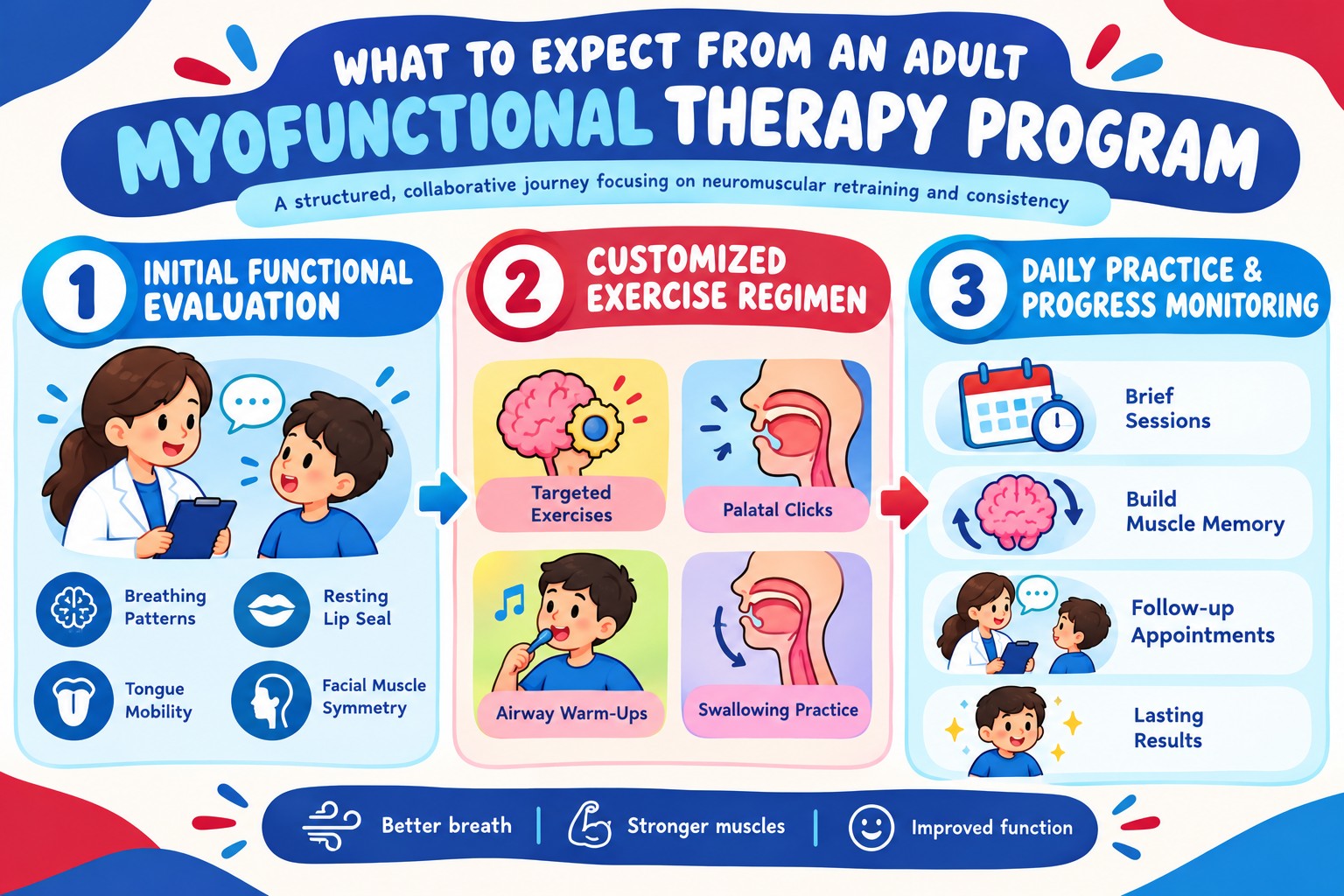
Embarking on an adult myofunctional program is a structured, collaborative journey that requires active patient participation. Because therapy focuses on neuromuscular retraining, consistency is the key to achieving lasting results.
Initial Functional Evaluation
The process begins with a thorough clinical assessment. A trained healthcare professional evaluates the patient’s oral anatomy, tongue mobility, resting lip seal, breathing patterns, swallowing mechanics, and facial muscle symmetry. The clinician also assesses whether physical restrictions, such as a restricted lingual frenulum (tongue-tie), are contributing to the functional movement limitations.
Customized Exercise Regimen
Based on the initial evaluation, a targeted exercise plan is developed. Unlike general physical therapy, myofunctional exercises are subtle, short, and focused. They involve specific movements designed to isolate and build control over individual muscle groups.
Examples of exercises include:
- Palatal Clicks: Pressing the tongue fully against the roof of the mouth and releasing it to build tongue body strength and awareness.
- Lip Resistance Drills: Holding small, light objects between the lips to improve lip tone and endurance without involving chin tension.
- Airway Warm-ups: Specific articulation and vocalization drills that engage the soft palate and upper pharyngeal muscles.
- Controlled Swallowing Practice: Re-learning how to swallow liquids and solids using correct tongue placement without facial grimacing.
Daily Practice and Progress Monitoring
Exercises are typically performed for a few minutes, two to three times per day. Because the goal is to build long-term muscle memory, brief, frequent daily sessions are significantly more effective than long, infrequent ones.
Patients attend regular follow-up appointments to review progress, refine movement techniques, and advance to more challenging exercises as muscle strength and coordination improve. Over the course of several months, conscious practice shifts into subconscious habit, embedding proper posture into daily life.
Overcoming Challenges in Adult Retraining
While the adult brain is fully capable of adapting, retraining muscles that have functioned a certain way for thirty, forty, or fifty years requires patience and focus. Adults often face unique challenges compared to pediatric patients, including busy work schedules, long-established movement habits, and structural compensations built up over a lifetime.
Success in adult therapy comes from establishing manageable daily routines. Integrating exercises into existing habits, such as practicing tongue holds during a morning commute, performing lip exercises while reading, or practicing swallows during meals, helps bridge the gap between clinical practice and daily life.
It is also important to maintain realistic expectations. Muscle retraining is a gradual process of building strength, tone, and neurological awareness step by step. With steady commitment and professional guidance, adults can achieve meaningful functional improvements that support long-term health.
Seeking Professional Guidance in Dubai
Taking the first step toward improving oral muscle function begins with a professional evaluation. Every individual presents a unique combination of anatomical structure, habit history, and functional needs. Working with a qualified multidisciplinary team ensures that care plans are tailored to specific goals and executed safely.
For those exploring options for myofunctional therapy Dubai offers access to specialized healthcare professionals who understand the intricate relationship between oral muscle function, airway health, and overall well-being. A qualified clinician can assess whether myofunctional retraining is appropriate for your needs, guide you through a structured exercise plan, and collaborate with other healthcare providers, such as dentists, orthodontists, or ENT specialists, to ensure balanced, comprehensive care.
Embracing Long Term Oral Muscle Health
Health is often measured by the larger systems of the body, yet small, everyday mechanics play an equally vital role in how we feel. The way we breathe, swallow, and rest our jaw influences our comfort, sleep quality, and daily vitality in ways that are easy to overlook until balance is restored.
It is a common misconception that adult bodies are set in stone and that functional habits established in childhood must simply be endured. Thanks to the remarkable adaptability of the human nervous system, adults of any age can learn to retrain their oral muscles, eliminate compensatory strain, and build healthier, more efficient movement patterns.
By investing time in understanding and caring for these foundational muscles, you take an active role in supporting your airway, relieving unnecessary facial tension, and enhancing your day-to-day quality of life. Retraining your muscles is a practical, empowering journey, and it is never too late to begin.
