
The First 30 Days: What to Expect When Starting ABA Therapy in Dubai

The First 30 Days: What to Expect When Starting ABA Therapy in Dubai
Taking the first step into Applied Behavior Analysis (ABA) therapy for your child is a profound moment. If you’re a parent in Dubai, you’ve likely navigated a complex path to get here, filled with research, consultations, and a mix of hope and uncertainty. You’ve heard ABA is the most scientifically-backed approach for children with autism, but what does it actually look like? What happens when you walk through the doors of a therapy center for the very first time?
That first month, those first 30 days, is a whirlwind of new information, new faces, and new routines. It’s a time of discovery, both for your child and for your family. It’s important to understand that this period isn’t about seeing dramatic changes overnight. Instead, it’s a crucial time of observation, relationship-building, and laying the groundwork for a successful and lasting therapeutic journey. Think of it less as a race and more as the essential foundation of a strong, beautiful building.
The Big Picture a Quick Primer on ABA
Before we dive into the day-by-day, let’s quickly define what modern ABA is. At its core, ABA therapy is a science that applies our understanding of how behavior works to real-life situations. The goal is to increase behaviors that are helpful (like communication, social skills, and self-care) and decrease behaviors that are harmful or get in the way of learning.
This is a far cry from the rigid, one-size-fits-all approach some people still imagine. In Dubai, like in other places with high-quality services, ABA is highly individualized and deeply empathetic. The team is led by a Board Certified Behavior Analyst (BCBA), who holds a master’s degree and extensive training. They design the therapy program, which is then implemented by trained behavior technicians (often called RBTs or Registered Behavior Technicians) who work directly with your child.
Phase One the First Week A Time of Discovery
This initial phase is all about gathering information and building a trusting relationship. It can feel a bit like a gentle dance where everyone is getting to know one another.
The Initial Assessment
When you first enroll your child, the BCBA will conduct a comprehensive assessment. This isn’t a test in the traditional sense; it’s a detailed, systematic observation of your child’s skills, strengths, and challenges.
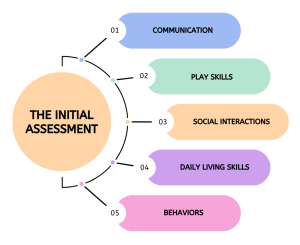
The Initial Assessment- Able UK
The BCBA will be looking at a range of things:
- Communication: How does your child communicate? Do they use words, gestures, pictures, or something else? Can they follow simple directions?
- Play Skills: How does your child play? Do they prefer solitary play, or can they engage in a back-and-forth game?
- Social Interactions: Do they make eye contact? Do they notice when others are in the room?
- Daily Living Skills: Can they help with getting dressed? Can they eat independently?
- Behaviors: What behaviors are a concern, and in what situations do they occur?
This assessment isn’t just a single event. It often involves a combination of direct observation, interviews with you and other caregivers, and sometimes the use of standardized assessments like the VB-MAPP (Verbal Behavior Milestones Assessment and Placement Program) or the ABLLS-R (Assessment of Basic Language and Learning Skills-Revised). These tools provide a clear picture of your child’s developmental level across various skill sets. Think of this as the GPS of your child’s therapeutic journey—the BCBA needs to know exactly where you are to map out the best route forward.
Building Rapport
Equally important during this first week is building rapport. The behavior technician and the BCBA are not there to demand compliance. Their first and most critical job is to become a positive presence in your child’s life. This involves following your child’s lead, joining in on their favorite activities, and simply being a source of fun and comfort. You might see the therapist spending a lot of time playing games, singing songs, or just sitting quietly with your child. This is a deliberate and crucial strategy to establish trust and make therapy a place your child wants to be. It’s an approach that is rooted in respect for the child’s perspective and emotional well-being.
Phase Two Weeks Two and Three the Journey Begins
Once the assessment is complete and a relationship has been established, the real work of therapy begins. This is when the BCBA takes the information from the first week and crafts a highly personalized treatment plan.
The Individualized Treatment Plan
The BCBA will develop a plan with clear, measurable goals tailored specifically to your child. This isn’t a generic checklist. It’s a living document that prioritizes goals based on what is most important for your child’s independence and quality of life. For example, if your child is non-verbal, a primary goal might be to teach them to use a picture card to request a favorite snack. If they have trouble with transitions, the goal might be to teach them a visual cue to help them move from one activity to the next more smoothly. The best plans also include parent goals, recognizing that your participation is a vital part of the therapeutic process.
What a Therapy Session Looks Like
A therapy session in Dubai, whether in a center or at home, will be very structured but will look a lot like play. A therapist might use colorful toys, puzzles, or sensory items to teach a skill.
You will see techniques like:
- Discrete Trial Training (DTT): This involves breaking a skill down into small, manageable steps and teaching each step one at a time. It’s highly effective for teaching foundational skills like matching colors or following a simple direction.
- Naturalistic Teaching: This approach is much more free-flowing. The therapist follows the child’s interests and uses those moments to teach. If a child reaches for a toy car, the therapist might prompt them to say “car” or “go” before giving it to them. This teaches communication in a natural and motivating context.
- Reinforcement: This is the cornerstone of ABA. When your child does something well—like making eye contact or saying a word—they get a reward. This reward is something they love, like a favorite toy, a tickle, or a small snack. This positive reinforcement encourages the child to repeat the behavior in the future. The use of reinforcement is what makes therapy so positive and effective.
Phase Three the End of the First Month Moving Forward
As you approach the end of the first 30 days, it’s a natural time to pause, reflect, and look ahead.
The First Progress Meeting
Around the one-month mark, you will have your first formal meeting with the BCBA to discuss progress. This meeting is vital. Don’t expect to hear about monumental changes just yet. Progress at this stage is often subtle but incredibly meaningful. The BCBA might share data showing that your child has started making eye contact more consistently or that they are now responding to their name with more regularity. They will use graphs and charts to show you the small, steady gains that are being made.
This is your time to ask questions. You might want to know:
- What are my child’s biggest strengths right now?
- What skills are we focusing on in the next month?
- How can I support these goals at home?
- What’s the timeline for introducing new skills?
Parent Training a Critical Component
A high-quality ABA program in Dubai places a strong emphasis on parent training. Your BCBA will begin to coach you on how to use ABA principles in your daily routines. They might teach you how to give a prompt, how to use reinforcement effectively, or how to create a more structured environment at home. This isn’t an added extra; it’s a foundational part of the therapy. Research shows that children make the most progress when their therapy is reinforced and supported by their family.
A Final Thought for Parents in Dubai
The first 30 days of ABA therapy for your child are a period of immense growth, learning, and adjustment for everyone involved. It’s a time to be patient with your child, with the therapists, and most importantly, with yourself. You are building a powerful partnership with a team of skilled professionals who are dedicated to helping your child thrive. As the weeks unfold in Dubai, you will see your child’s therapy team not just as providers of a service, but as true partners in your family’s journey. You have taken a monumental step, and with a solid foundation now in place, you can look forward to the many small and significant victories that lie ahead.
