ABA Therapy for Autism in Dubai
ABA therapy for autism at ABLE UK is individual, play-led support that helps autistic children communicate, connect and take part in daily life in ways that feel right for them. Our programmes build on your child’s interests and natural motivation rather than trying to make them appear less autistic. Sessions run at our Dubai Healthcare City and JLT clinics, in English or Arabic.
This page is part of our Applied Behaviour Analysis (ABA) service. It explains how we approach ABA therapy for autistic children, what a programme includes, and how you can get started.
What ABA therapy for autism means at ABLE UK
Applied behaviour analysis is the science of how behaviour is learned and what keeps it going. The Behavior Analyst Certification Board describes it as an approach based on behaviour and its consequences, with an emphasis on positive reinforcement and on teaching more effective ways of doing things. You can read its overview of behaviour analysis.
For an autistic child, that science is only useful when it is pointed at goals that matter to the child and family. At ABLE UK, ABA therapy for autism focuses on skills that give your child more ways to be understood, more choice and more independence. It does not aim to remove harmless autistic traits such as stimming, special interests or a preference for routine.
A neurodiversity-affirming, assent-based approach
Modern ABA practice has moved a long way. Some autistic adults have spoken about older forms of behaviour therapy that focused on compliance and on hiding autistic behaviour. We take those experiences seriously, and they shape how our ABA team works.
Building on interests and motivation
We start with what your child already enjoys. A love of trains, water play or a favourite song becomes the doorway to new skills, so learning feels meaningful rather than imposed.
Assent at every session
Assent means your child’s willingness to take part, shown through words, gestures, body language or moving towards an activity. Therapists watch for it throughout each session. If a child signals that they need a break or want to stop, we respect that and adjust.
Goals that support, not mask
Every goal is checked against one question: will this help your child have a safer, easier or more fulfilling life? Goals such as asking for help, saying no, or coping with a change of plan pass that test. Goals such as forcing eye contact do not.
Areas an ABA programme can support
Each autistic child’s profile is different, so each ABA programme is different. Most programmes draw on one or more of the following areas.
Communication and connection
We help children find reliable ways to request, comment, refuse and share, using speech, signs, pictures or an augmentative and alternative communication (AAC) device. The aim is connection on your child’s terms, including with siblings and peers. Our ABA team works closely with our speech and language therapists on communication goals, and our blog explains more about how ABA supports communication, social and life skills.
Flexible routines and transitions
Many autistic children find unexpected change hard. Rather than removing routine, we use visual schedules, warnings, choice boards and gradual practice so that transitions, such as leaving the park or starting a new class, become more predictable and less stressful.
Self-advocacy and autonomy
Knowing how to say “I need a break”, “too loud” or “I want that one” gives a child real control over their day. We teach self-advocacy skills early and build them over time, alongside daily living skills such as dressing, toileting and mealtimes.
Emotional regulation and wellbeing
When behaviour is difficult, we look for the reason behind it first, such as sensory overload, pain, or not having another way to communicate. Support then focuses on meeting that need and teaching a calmer alternative, never on punishment.
Is ABA therapy right for every autistic child?
No single therapy suits every child. ABA therapy can be a good fit when there are specific, practical goals, such as communicating needs, joining in with play or managing daily routines, and when the family wants structured support with regular progress reviews. For some children, speech and language therapy, occupational therapy or a combination will meet their needs better. Our blog covers the signs your child may benefit from ABA therapy. At your first consultation we will give you an honest view of whether ABA is the right starting point.
How we build your child’s ABA programme
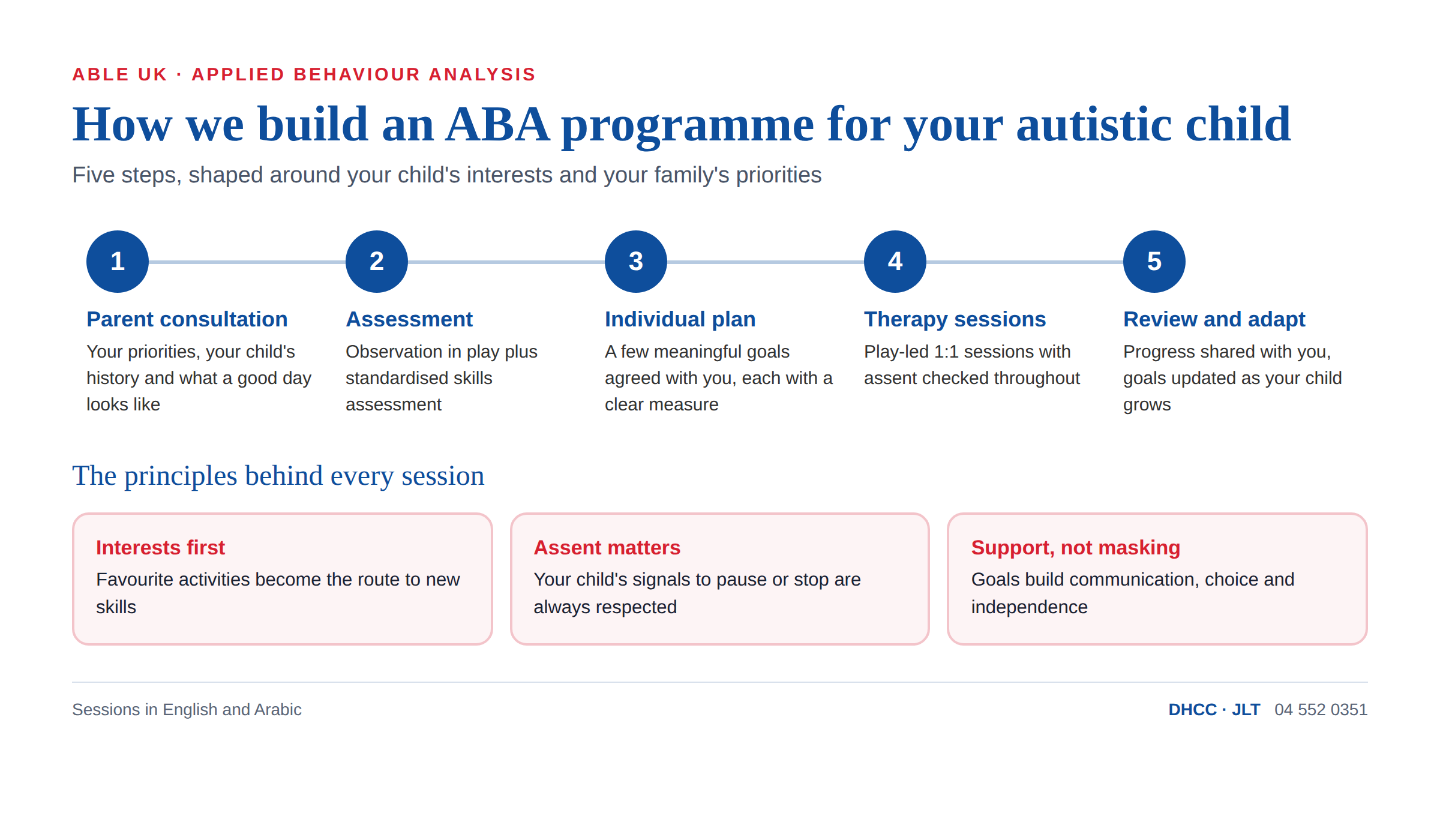
- Parent consultation. We listen to your priorities, your child’s history and what a good day looks like for your family.
- Assessment. A behaviour analyst observes your child in play and structured activities, and uses standardised skills assessments to understand communication, play, social and daily living skills.
- Individual programme. We agree a small number of meaningful goals with you and write them into a plan, with clear ways to measure progress.
- Therapy sessions. One-to-one sessions combine play-based learning with short, structured teaching, with assent checked throughout.
- Review and adapt. Progress data is reviewed regularly and shared with you, and goals are updated as your child grows.
What a typical ABA session looks like
A session for a young autistic child often looks a lot like play. A therapist might set up a favourite activity so that your child has natural reasons to communicate, take turns or try a new step. Short periods of focused teaching sit alongside movement breaks, sensory activities and free choice. For older children, sessions may focus on conversation skills, managing frustration, organising tasks or preparing for school. How ABA sessions change as children grow is covered in our article on what ABA progress looks like at different ages.
How we measure progress
Every goal in an ABA programme has a clear, observable measure, such as how often your child requests a break independently or how smoothly they move between activities. Therapists record progress during sessions, and the supervising analyst reviews the data regularly to check whether teaching is working. You receive updates in plain language, with examples from sessions and from home. If a goal is not moving, we change the teaching approach rather than expecting your child to try harder.
Parents and carers as partners
Children spend far more time at home than in therapy. Every programme includes parent coaching, so you learn the strategies your child’s therapist uses and can apply them in everyday moments such as meals, bath time and outings. You are always welcome to observe sessions and ask questions.
ABA alongside speech, occupational and feeding therapy
Many autistic children benefit from more than one kind of support. Because ABLE UK brings several disciplines together under one clinical team, your child’s behaviour analyst can share goals and strategies directly with their speech and language therapist, occupational therapist or feeding therapist. If you are still looking for answers about your child’s development, our psychological evaluation service can help.
Your ABA team
ABA programmes at ABLE UK are delivered by an experienced team whose training includes:
- Sarah Amin: MSc Applied Psychology, BCaBA, QBA, IBA, ADOS-2 certified
- Ciby Koshy: IBA, QASP-S, DHA licensed, 11 years at ABLE UK
- Marife Romero Parong: BA Psychology, QABA ABAT, RBT, more than 10 years at ABLE UK
- Dennis Mangundayao: BSc Clinical Psychology, RBT, QABA ABAT, DIR/Floortime trained
- Mervin Valmonte Javier: BSc Nursing, RBT, QASP-S
You can read more about each clinician on our team page.
ABA therapy for autism in Dubai Healthcare City and JLT
ABLE UK has supported children and families in Dubai since 2014, drawing on more than 25 years of clinical heritage in the UK. ABA sessions and parent coaching are available in English and Arabic at both of our clinics:
- Dubai Healthcare City: 2nd Floor, Building 33, Dubai Healthcare City
- Jumeirah Lake Towers: 1605, 16th Floor, Fortune Executive Tower, Cluster T, JLT
To book an initial ABA consultation, call 04 552 0351, message us on WhatsApp at +971 52 774 5062 or use our contact form.
Frequently asked questions about ABA therapy for autism
What is ABA therapy for autism?
ABA therapy for autism uses the science of how behaviour is learned to help autistic children build skills that matter to them, such as communicating needs, managing change and becoming more independent. At ABLE UK, programmes are play-led, based on each child’s interests and designed with the family.
Is ABA therapy at ABLE UK neurodiversity-affirming?
Yes, our ABA therapy is neurodiversity-affirming and assent-based. We do not try to stop harmless autistic traits such as stimming or special interests, and therapists respect your child’s signals when they need a break or want to stop an activity.
What age can a child start ABA therapy?
ABA therapy can start at any age once there are clear goals that would help a child and family. Programmes for young children are mostly play-based, while programmes for older children often focus on communication, regulation and independence skills for school and home.
Does my child need an autism diagnosis to start ABA therapy?
You can contact us for an initial consultation before or after a formal diagnosis. If your child has not yet been assessed, we can explain the options, including our psychological evaluation service, and discuss whether ABA is the right starting point.
How many hours of ABA therapy will my child need?
The number of ABA therapy hours is set after assessment and depends on your child’s goals, age and energy levels, as well as your family’s routine. Hours are reviewed regularly and adjusted as your child progresses.
What happens in an ABA therapy session?
An ABA therapy session usually combines play-based learning with short periods of focused teaching, broken up by movement and sensory breaks. Therapists use your child’s favourite activities to create natural chances to communicate, take turns and practise new skills.
Do you offer ABA therapy in Arabic in Dubai?
Yes, ABLE UK offers ABA therapy and parent coaching in Arabic and English at our Dubai Healthcare City and JLT clinics, so your child can learn in the language used at home.
Can ABA therapy be combined with speech therapy or occupational therapy?
Yes, ABA therapy can be combined with speech and language therapy, occupational therapy or feeding therapy at ABLE UK. Our therapists work as one team and share goals, so your child gets consistent support across every session.
Book an ABA consultation
Talk to our ABA team about your child’s strengths, your priorities and whether ABA is the right starting point.
More from our ABA service:Applied Behaviour Analysis overview · ADHD and Attention Difficulties · Developmental Delays · Communication and Social Skills · Behaviour Support and Regulation · School Readiness and Adaptive Skills
Clinically reviewed by Ciby Koshy, ABA Therapist and Behaviour Analyst at ABLE UK (IBA, QASP-S, DHA licensed).