Bridging The Gap | Empowering Families To Generalize Skills At Home

Bridging The Gap | Empowering Families To Generalize Skills At Home
The journey of development and skill acquisition is a collaborative partnership that extends far beyond the walls of a clinical setting. While structured sessions provide the foundation for learning, the true measure of success lies in a child’s ability to use those new skills naturally in their everyday life. For families exploring ABA Therapy for kids Dubai has a wealth of professional resources, but the most profound transformations often happen right at the kitchen table, in the local park, or during the evening bedtime routine.
When parents actively participate in the learning process, they become the bridge that connects clinical progress with real-world independence. This does not mean turning your home into a rigid classroom or taking on the role of a full-time therapist. Instead, it is about finding small, meaningful opportunities throughout the day to encourage communication, foster independence, and celebrate positive behavior. By weaving these learning goals into your family’s natural rhythm, you can create a supportive environment where progress thrives.
Understanding The Power Of Generalization
In the field of behavioral support, generalization is the term used when a child takes a skill learned in a specific, structured environment and applies it across different settings, with different people, and in different situations. A child might easily point to a picture of an apple when asked by their therapist in a quiet room, but the ultimate goal is for that child to independently ask for an apple at a local grocery store or during a family snack time.
Generalization does not always happen automatically. It requires intentional practice and encouragement across various contexts. When parents understand this concept, they can see the immense value of their everyday interactions. You are not just repeating exercises; you are helping your child understand that the skills they learn during their sessions are useful and relevant to the entire world around them.
Creating A Supportive Home Environment
The physical and emotional atmosphere of the home plays a significant role in how easily a child can practice new skills. A supportive home environment is one that balances predictability with opportunities for growth. It is a space where children feel safe enough to try, make mistakes, and try again.
Establishing Clear Routines
Predictability reduces anxiety and creates a sense of security, which is essential for learning. Setting up consistent daily routines for mornings, mealtimes, and evenings helps your child know what to expect. Within these routines, you can naturally embed specific learning goals. For example, if a current goal focuses on independent dressing, the morning routine can be structured to give your child the extra time they need to practice buttoning their shirt without feeling rushed.
Setting Up The Physical Space
You can modify your living space slightly to encourage independent communication and problem-solving. If a child always has their favorite toys or snacks within arm’s reach, they have very little reason to communicate their needs. By placing preferred items on a shelf where they are visible but out of reach, you gently create an opportunity for your child to use their words, gestures, or communication device to make a request.
Integrating Learning Goals Into Daily Routines
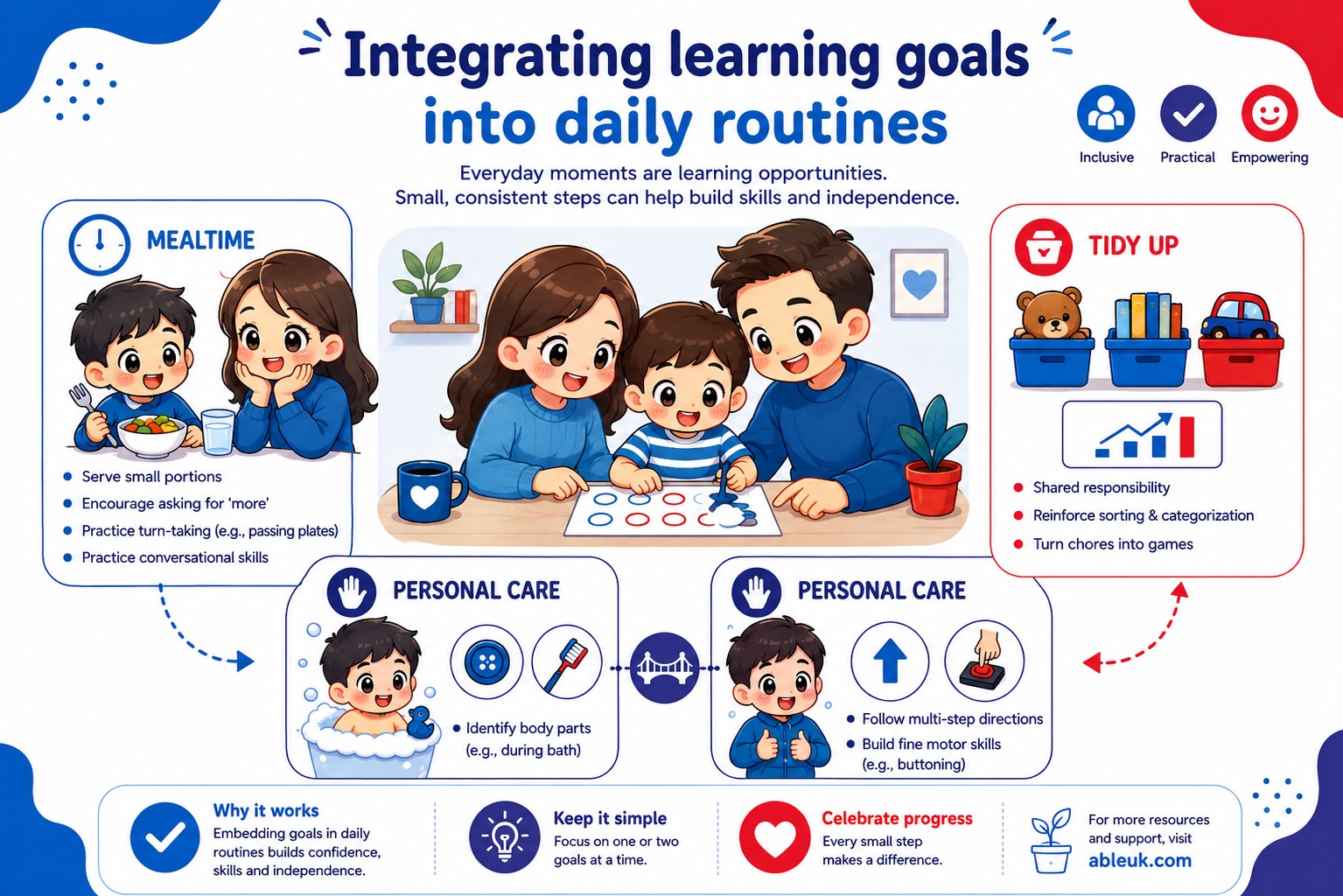
The most effective way to support progress outside of formal sessions is to integrate goals into activities you are already doing. This approach ensures that practice feels natural rather than demanding, reducing resistance from the child and stress for the parent.
Mealtimes As Communication Hubs
Mealtimes are rich with opportunities for social interaction and language development. Instead of serving an entire meal at once, consider serving small portions. This naturally encourages your child to ask for more. You can also practice social skills like turn-taking by passing plates or sharing a side dish. For older children, mealtimes can be an excellent time to practice conversational skills, such as answering simple questions about their day or expressing their preferences.
Bath Time And Personal Care
Personal care routines are ideal for building self-help skills and body awareness. During bath time, you can practice identifying body parts or following multi-step directions, such as first washing your hands and then drying them with a towel. These moments also allow for the practice of fine motor skills, like squeezing a bottle of shampoo or gripping a toothbrush. By breaking these tasks down into smaller steps and offering gentle encouragement, you help your child build confidence in their physical abilities.
Tidy Up Time And Responsibility
Learning to clear away toys is a valuable functional skill that promotes responsibility and cooperation. You can make this a shared activity by using simple, direct instructions. Sorting toys into designated bins can also reinforce cognitive skills like categorization. For example, placing all the blocks in one box and all the cars in another turns a necessary household chore into a meaningful learning game.
Integrating Learning Goals Into Daily Routines
Effective Communication Strategies At Home
The way we speak to our children greatly influences how they process information and respond to requests. Using clear, positive, and intentional communication can significantly reduce frustration for both you and your child.
Keeping Language Simple And Direct
When giving instructions, it is helpful to use clear and concise language. Long, complex sentences can sometimes overwhelm a child, making it difficult for them to identify the actual request. Instead of saying, “It is getting late and we need to go to the store, so please go get your shoes from the closet and put them on,” you might break it down into, “Please get your shoes.” Once that step is complete, you can follow up with the next instruction.
The Power Of Positive Reinforcement
Positive reinforcement is one of the most effective tools for encouraging desired behaviors. This involves acknowledging and celebrating your child’s efforts and successes, no matter how small they might seem. Reinforcement can take many forms, including specific verbal praise, a high-five, a favorite activity, or a few minutes of shared playtime. The key is to make the reinforcement immediate and specific, so your child understands exactly what behavior is being celebrated.
A Quick Example of Specific Praise: Instead of saying a general “Good job,” try saying, “I love how beautifully you used your words to ask for that toy!” This helps the child connect the praise directly to the positive action.
Managing Challenging Moments With Consistency
It is entirely natural to encounter challenging behaviors or resistance when introducing new expectations at home. Consistency is your greatest asset during these times. When a child experiences the same gentle, firm boundaries from both their therapists and their parents, they feel more secure and learn to adapt more quickly.
Identifying The Purpose Behind Behaviors
Every behavior serves a purpose or communicates a need. A child might misbehave to avoid a difficult task, to gain attention, or to express frustration when they cannot communicate effectively. By observing what happens right before and right after a challenging behavior, you can begin to understand what your child is trying to express. This understanding allows you to address the root cause of the behavior rather than just reacting to the behavior itself.
Staying Calm And Patient
Children often feed off the emotional energy of the adults around them. Remaining calm and composed during a meltdown or a moment of defiance helps de-escalate the situation. Take a deep breath, use a low, soothing tone of voice, and give your child the space they need to regulate their emotions. Once the emotional storm has passed, you can gently guide them back to the task or skill you were practicing.
Collaborating Closely With Your Care Team
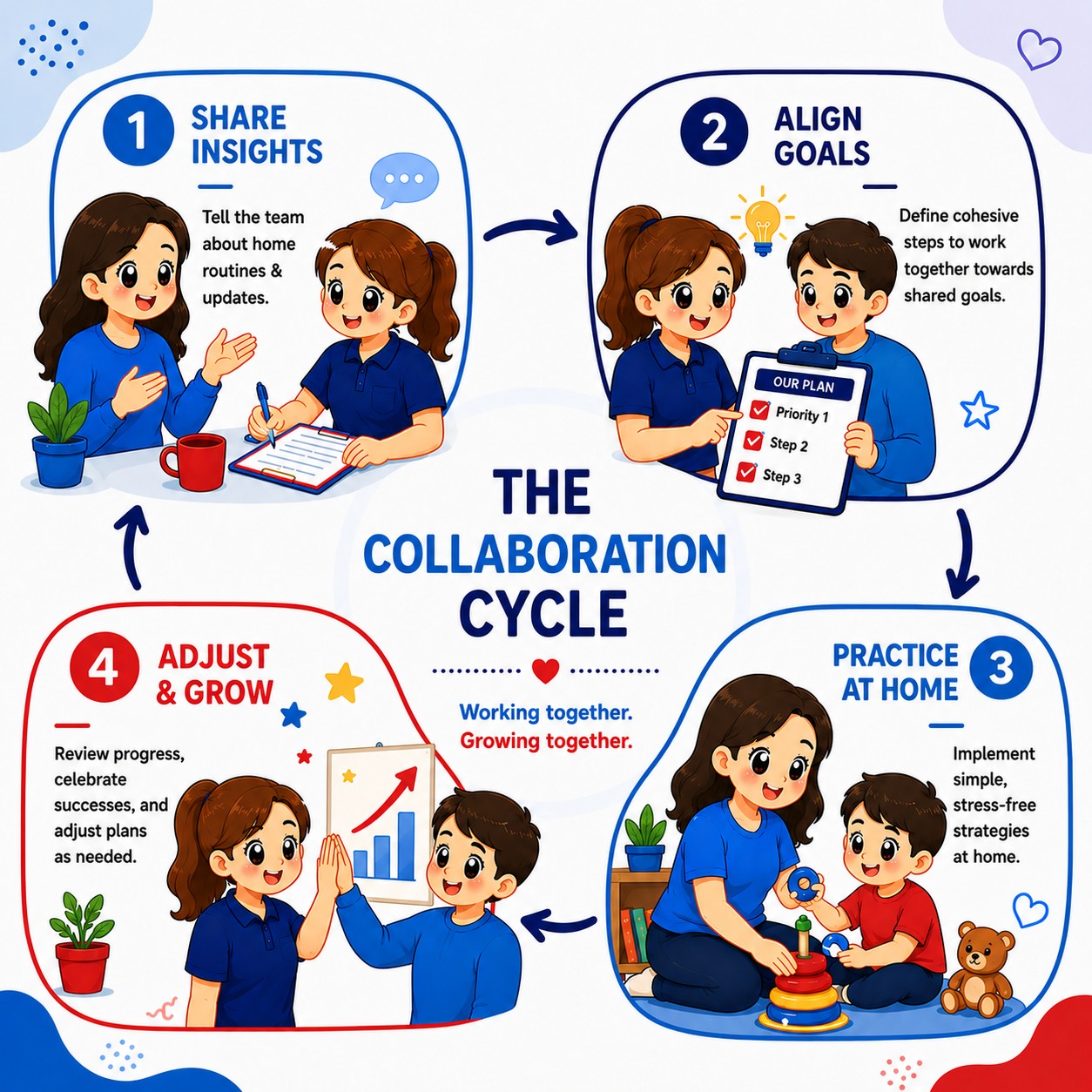
You are the foremost expert on your child, and your insights are incredibly valuable to the professionals supporting your family. Open, ongoing communication with your care team ensures that home strategies and clinic strategies are perfectly aligned.
Regular Progress Updates
Make it a habit to share updates with your child’s team. Let them know what is working well at home and where you are encountering challenges. If your child successfully uses a new phrase at the dinner table, share that win! If a particular routine is causing intense frustration, discuss it with the team so they can help you modify the approach or break the skill down into even smaller, more manageable steps.
Observing And Participating In Sessions
Whenever possible, take the opportunity to observe sessions or participate in parent coaching discussions. Watching a professional interact with your child can provide you with practical examples of how to give instructions, offer reinforcement, and manage behavioral challenges. It also allows you to ask questions in real-time and gain confidence in applying these techniques at home.
Balancing Support With Family Well-Being
While supporting your child’s development is a top priority, it is equally important to maintain a healthy balance that protects the well-being of the entire family. Sustainable progress is built on a foundation of care, patience, and mutual support.
Prioritizing Quality Over Quantity
You do not need to turn every single waking moment into a teaching opportunity. Doing so can lead to burnout for both you and your child. Instead, focus on a few high-quality interactions each day. Ten minutes of focused, joyful, and supportive practice during a shared activity is far more beneficial than hours of forced, stressful exercises.
Celebrating The Journey
Development is a journey filled with ups and downs. There will be weeks of rapid progress followed by periods where growth seems to slow down. Celebrate the small victories along the way. Whether it is a new word, an independent step in a self-care routine, or a moment of calm cooperation, these milestones are proof of your dedication and your child’s hard work.
Moving Forward With Confidence
Empowering your child to reach their full potential is a beautiful and deeply rewarding endeavor. By taking the principles of structured support and weaving them into the warm, familiar context of your daily family life, you provide your child with the ultimate environment for growth.
Remember that you are not on this path alone. The dedicated community providing ABA Therapy for kids Dubai serves as a continuous source of guidance, expertise, and encouragement. Together, as a unified team, you can bridge the gap between clinical learning and everyday life, helping your child build the skills, confidence, and independence they need to thrive in the world around them. Give yourself grace, celebrate the progress, and trust in the lasting impact of your everyday dedication.
The Collaboration Cycle
