
Enhancing Your Child’s Daily Living Skills Through Occupational Therapy
Enhancing Your Child’s Daily Living Skills Through Occupational Therapy
When a child begins to explore the world, everyday tasks can feel like a maze filled with new sensations, challenges, and opportunities. Simple routines such as brushing teeth, using utensils, dressing, or even playing with peers become building blocks for independence. Yet for many children, these skills do not come easily. Difficulties with motor planning, sensory processing, coordination, or communication can turn daily routines into moments of frustration rather than growth.
This is where occupational therapy steps in. It provides structured support that helps children strengthen the abilities needed for everyday life. Rather than focusing solely on one area of development, occupational therapy looks at the whole child. It considers their environment, their strengths, their challenges, and the activities they interact with throughout the day. In doing so, occupational therapists help children experience success in meaningful ways that build confidence and independence over time.
Understanding Daily Living Skills in Childhood
Understanding Daily Living Skills in Childhood- ABLE UK
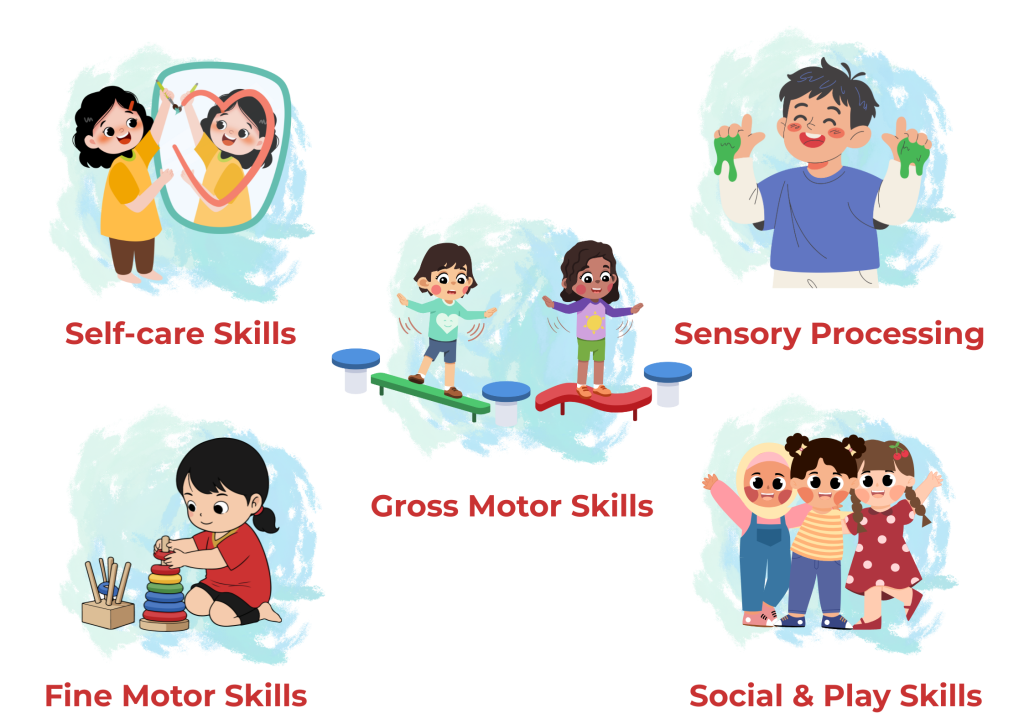
Daily living skills, often called functional or self-care skills, are the routines that help children meet their personal needs and participate comfortably at home, school, and in the community. These skills fall into several important areas.
- Self-care skills include brushing teeth, bathing, toileting, dressing, eating, and managing sleep routines. When children find these activities difficult, parents often step in more than expected, which can add stress to everyday life.
- Fine motor skills involve the small movements of the hands and fingers. Activities such as holding a pencil, opening containers, using scissors, or fastening clothing depend on strong fine motor control.
- Gross motor skills relate to larger body movements. Tasks like climbing, jumping, sitting upright with steady posture, or carrying school items require coordination and physical strength that some children need help developing.
- Sensory processing affects how children respond to sounds, lights, textures, movement, and other environmental input. Some children feel overwhelmed by certain sensations, while others seek extra movement or pressure to feel regulated. These differences often influence how smoothly routines unfold.
- Social and play skills help children join activities with peers, take turns, communicate needs, manage emotions, and participate in group settings. These skills support confidence and comfort in daily interactions.
Occupational therapists strengthen each of these skill areas while breaking larger goals into manageable steps. This makes progress feel achievable and encourages children to build independence over time.
Why Some Children Struggle With Daily Living Skills
There are many reasons why a child may have difficulties with everyday tasks. Some children experience delays in fine or gross motor development. Others have challenges related to attention, sensory processing, or planning movements. Conditions such as autism, ADHD, developmental coordination disorder, or sensory processing differences can also impact how children engage with their routines.
Parents sometimes notice early signs, such as a child who frequently avoids certain clothing fabrics, gags at new food textures, has trouble holding a pencil, becomes frustrated during transitions, or seems constantly on the move. These behaviors are not signs of laziness or stubbornness. They are often indicators of underlying difficulties that occupational therapy is designed to address.
Children learn best through consistent practice, encouragement, and hands-on exploration. When a child has the right support, they can develop skills in ways that feel natural and enjoyable rather than forced.
How Occupational Therapy Supports Daily Living Skills
Occupational therapy uses evidence-based strategies that help children strengthen foundational skills and apply them to real-life situations. The process begins with an assessment, where the therapist observes how the child performs key tasks and identifies strengths, preferences, and challenges. From there, an individualized plan is created that fits the child’s abilities and daily environment.
Here are some of the most common areas of support and how occupational therapy helps.
Building Fine Motor Strength and Coordination
Children practice skills such as holding writing tools, manipulating small objects, and using both hands together. Therapists may use creative activities like threading beads, squeezing putty, drawing, or building with blocks. These activities are fun for children yet provide valuable practice that translates to daily life.
Fine motor progress also supports independence in tasks such as buttoning clothes, opening lunch containers, using utensils, and brushing teeth. When children gain confidence with their hands, they often become more willing to try new tasks.
Improving Gross Motor Skills and Body Awareness
Many children benefit from activities that help them strengthen their core muscles, improve balance, and enhance coordination. Therapists may design obstacle courses, climbing tasks, ball games, and movement exercises. Children enjoy these activities, and parents often see improvements in posture, endurance, and participation in school or sports.
Better gross motor development also supports emotional regulation. When children feel secure in their bodies, they typically become more comfortable in social and academic environments.
Supporting Sensory Processing
Children experience the world through their senses. When sensations feel too intense or not intense enough, everyday routines can become difficult. Occupational therapists create sensory-based strategies that help children feel more balanced and comfortable.
These strategies may include calming activities, deep pressure input, movement breaks, or exposure to textures in structured ways. Over time, children become better at managing sensory experiences, which reduces behavioral challenges and increases participation.
Parents often notice fewer struggles with grooming, eating, transitions, or new environments once sensory supports are in place.
Strengthening Self-Care and Routine Tasks
Many families seek occupational therapy because daily routines feel overwhelming. Tasks such as dressing, toileting, or eating can become moments of stress when a child is unsure how to complete each step.
Therapists break down these routines into smaller, manageable parts. They use visual tools, modeling, and repetition to help children understand what to do and how to do it. These approaches build independence gradually and reduce frustration for both children and parents.
Confidence grows each time a child completes a task successfully, creating positive momentum for future progress.
Encouraging Emotional Regulation and Coping Skills
Daily life involves transitions, unexpected changes, and moments that challenge patience. Some children struggle to manage their emotions during these parts of the day. Occupational therapists teach children how to recognize their feelings, respond to stress, and regain a sense of calm.
These strategies may include breathing exercises, sensory calming tools, structured play, and communication supports. With practice, children learn how to participate in routines without frequent meltdowns or anxiety.
Why Early Support Matters
Although children can benefit from occupational therapy at any age, early intervention often leads to faster and more lasting progress. Young children’s brains are highly adaptable, which means early learning is absorbed quickly and naturally.
When families seek support early, children are better prepared for school, daily transitions become smoother, and emotional regulation improves. Early intervention also gives parents tools that they can apply consistently at home, school, and in the community.
Even so, it is never too late for a child to benefit. Older children and teenagers can also develop skills that strengthen independence, confidence, and participation in meaningful activities.
Real-Life Examples of Progress Through Occupational Therapy
Parents often share stories about the difference occupational therapy made in their child’s everyday life. A child who once refused to wear socks because of the seams might learn how to tolerate different textures through slow, supportive sensory activities. Another child who found it hard to sit upright during school lessons may develop better core strength, making learning more enjoyable.
Some parents describe mealtimes that went from stressful to peaceful after their child received help with feeding skills and sensory tolerance. Others talk about their child gaining confidence in sports, writing, playing with friends, or managing frustrations.
These changes may seem small on the surface, but they create meaningful improvements in family life and the child’s long-term abilities.
The Role of Parents in Supporting Daily Living Skills
Occupational therapy is most effective when parents are part of the process. Therapists often provide strategies that families can use throughout the day. These may include sensory routines, play-based exercises, visual schedules, or step-by-step prompts.
When families practice these supports consistently, progress becomes faster and more lasting. Daily tasks turn into learning moments rather than battles, and children experience success more often.
Open communication between therapists, parents, and teachers also helps ensure that children receive consistent support in all environments.
Small Steps That Lead to Big Progress
The journey toward independence is unique for every child. Some develop daily living skills quickly, while others need more time and guidance. Occupational therapy celebrates small wins and uses them to create long-term momentum.
Each new skill becomes a stepping stone to greater independence. Whether a child learns to tie their shoes, sit comfortably at a desk, follow a routine, or try a new food, every achievement contributes to a stronger foundation for life.
Children thrive when they feel understood, supported, and encouraged. By focusing on daily living skills, families and occupational therapists work together to create a path where children can grow with confidence and joy.
