How Speech Therapy Supports Children With Pronunciation Difficulties
How Speech Therapy Supports Children With Pronunciation Difficulties
Every child possesses a unique timeline for development, a personal rhythm by which they learn to navigate the world around them. Among the many milestones that parents eagerly anticipate, the emergence of clear, confident speech is often one of the most rewarding. Watching a young mind attempt to shape thoughts into spoken words is a beautiful process, yet it can occasionally be met with subtle hurdles.
When a child experiences persistent challenges with clarity, it can impact their ability to share their thoughts, feelings, and everyday needs. This is where dedicated professional guidance becomes invaluable. Exploring specialized options, such as seeking targeted Speech Therapy Dubai services, offers families a clear, supportive pathway. By understanding how communication develops and identifying the exact areas where a child needs a helping hand, speech and language professionals help young learners find their true voice.
Understanding The Foundation Of Speech Sound Development
Speech is a remarkably intricate physical and cognitive process. To produce even a single word accurately, a child must coordinate their breath, vocal cords, tongue, lips, and palate with split second precision. During the early years of life, it is entirely normal for children to simplify words as they master these complex motor movements. A toddler saying “nana” for banana or “wabbit” for rabbit is simply navigating the standard stages of phonetic acquisition.
As children grow, their ability to articulate complex sounds naturally sharpens. By specific age milestones, certain sounds should become stable and consistent. However, when these developmental simplifications persist past the expected age, they transition from standard developmental quirks into distinct pronunciation difficulties.
Speech and language professionals generally categorize these challenges into two primary areas: articulation issues and phonological process challenges. Articulation focuses on the physical movement of the mouth structures to produce specific sounds, such as a child struggling with the placement of the tongue for the “s” or “r” sounds. Phonological challenges, on the other hand, involve patterns of sound errors, such as consistently leaving off the final consonants of words or substituting all back of the mouth sounds, like “k” and “g”, with front of the mouth sounds, like “t” and “d”. Recognizing these differences is the very first step toward creating a meaningful intervention plan.
The Broader Impact Of Pronunciation Challenges On A Child
When a child finds it difficult to make themselves understood, the implications often extend far beyond the immediate frustration of a misunderstood sentence. Communication is the foundational tool for human connection, learning, and emotional expression. When that tool does not function smoothly, a child may experience a ripple effect across various areas of their daily life.
Social Dynamics And Peer Relationships
In playgroups, nurseries, and school classrooms, children connect through rapid, spontaneous conversation. A child who struggles with pronunciation may find it difficult to join in on games, share jokes, or express their ideas during group play. If peers regularly ask them to repeat themselves, or if they struggle to make their intent clear, the child might begin to withdraw. Over time, this can lead to feelings of isolation or a preference for solitary play, purely to avoid the vulnerability of being misunderstood.
Academic Progression And Literacy
There is a profound, deeply researched connection between spoken language and written language. Before a child learns to read and write, they must develop a strong sense of phonological awareness, which is the ability to recognize and manipulate the spoken parts of sentences and words. If a child consistently mispronounces a sound or substitutes one sound for another in speech, they are highly likely to map those same errors onto their reading and writing. For instance, a child who pronounces “three” as “free” may struggle with spelling patterns involving the “th” blend, creating avoidable academic hurdles as school workloads increase.
Emotional Well Being And Self Esteem
Children are highly perceptive. They quickly become aware when their communication style differs from their peers or when adults consistently struggle to interpret their words. This awareness can manifest as situational anxiety, reluctance to speak up in public, or behavioral outbursts born directly from deep frustration. By addressing these speech hurdles early, we protect not just a child’s academic future, but their core sense of confidence and emotional security.
How Specialized Speech Intervention Works
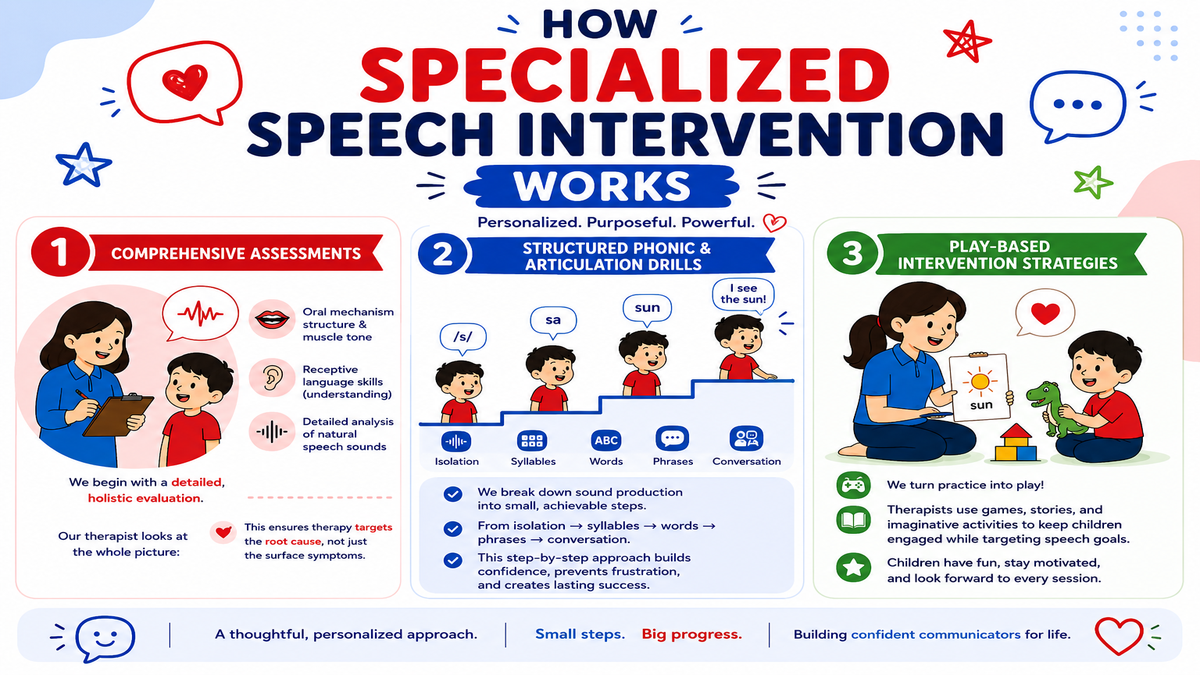
Approaching Speech Therapy can sometimes feel daunting for families who are unfamiliar with the process. However, the modern therapeutic approach is deeply collaborative, supportive, and designed to feel like a natural extension of a child’s routine. Specialist Speech Therapy Dubai services focus on creating an environment where children feel secure enough to take risks and practice new skills.
Comprehensive Assessments
The journey always begins with a detailed, holistic evaluation. A speech and language therapist does not merely listen to a child speak; they look at the whole picture. This includes evaluating the structural integrity and muscle tone of the oral mechanism, assessing receptive language skills to ensure the child understands spoken words well, and analyzing a detailed sample of the child’s natural speech sounds. This careful assessment ensures that therapy targets the root cause of the difficulty rather than just the surface symptoms.
Structured Phonic And Articulation Drills
Once a specific target sound is identified, therapy breaks down production into highly manageable steps. A child rarely moves straight to practicing a difficult sound in full sentences. Instead, they might start by learning to make the sound completely in isolation. From there, they progress to syllables, then to single words, followed by short phrases, and eventually, natural, unprompted conversation. This step by step scaffolding ensures the child experiences consistent success, preventing frustration and building momentum.
Play Based Intervention Strategies
For young children, play is their primary language. Highly skilled therapists seamlessly weave rigorous speech exercises into engaging games, imaginative play, and interactive storytelling. A child might believe they are simply playing a board game or helping a toy character find hidden treasures, but every turn they take is deliberately designed to prompt the repetition of target speech sounds. This approach keeps energy levels high and ensures that children look forward to their therapeutic sessions.
The Crucial Role Of Family Involvement
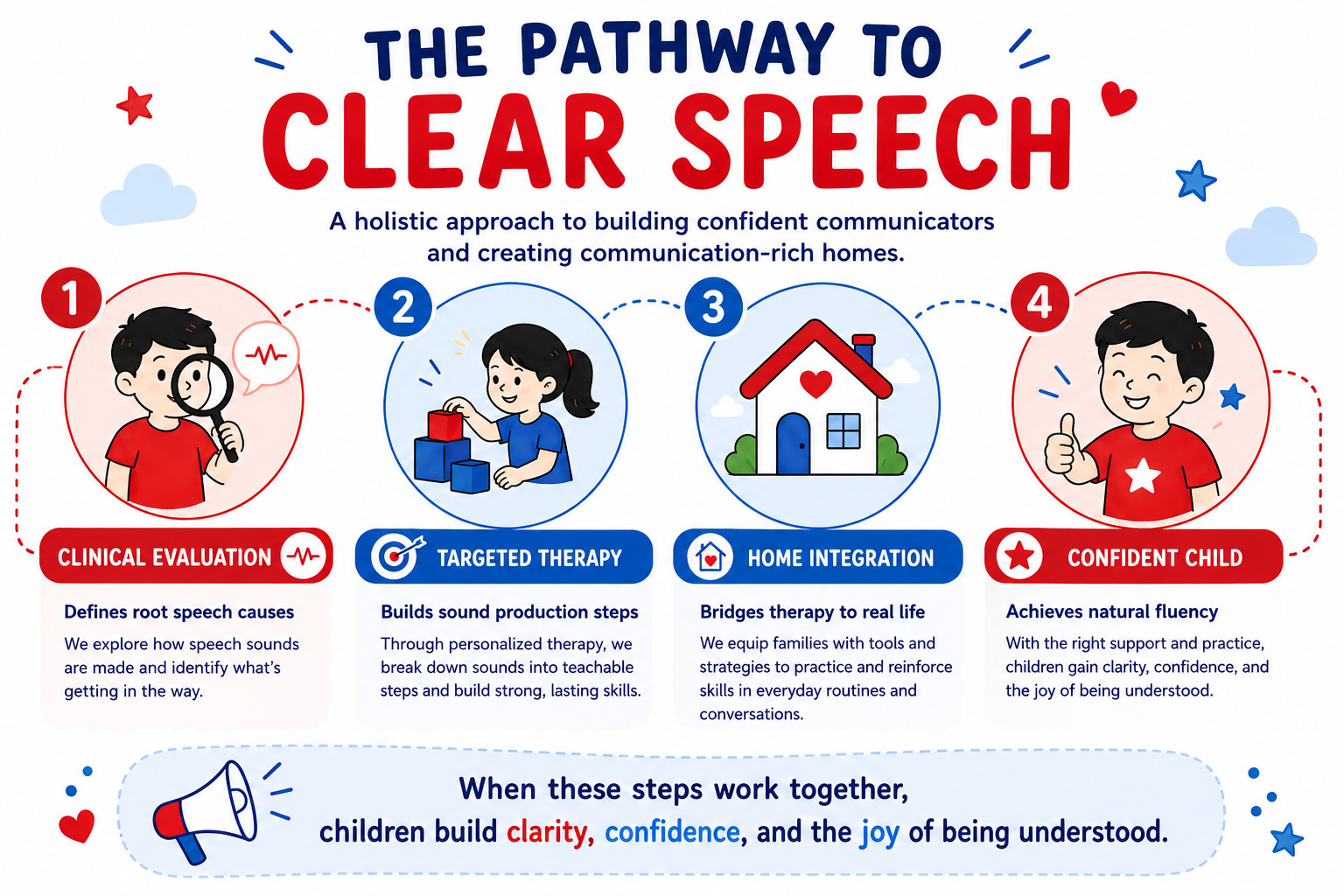
While the time spent with a speech and language therapist is highly structured and impactful, the real transformation occurs during the hours between sessions. A therapist provides the tools, strategies, and clinical expertise, but the family environment provides the ultimate practice ground for real world application.
Creating A Communication Rich Home
Families can support speech growth by making minor, conscious adjustments to how they interact throughout the day. One of the most effective strategies is modeling rather than over correcting. If a child points to a car and says, “Look at the tar,” an adult can simply respond with positive reinforcement and clear modeling: “Yes, look at that big, red car!” This provides the child with the correct auditory target without creating a sense of failure or making them self conscious about their speech.
Dedicated At Home Practice
Consistency is the absolute key to rewiring neural pathways and building muscle memory for speech sounds. Dedicating just ten to fifteen minutes a day to the specific games or exercises recommended by the therapist can accelerate progress dramatically. These sessions should be kept light, positive, and completely free of pressure. Celebrating the effort a child puts into attempting a difficult sound is just as important as celebrating a perfectly pronounced word.
Patience And Pacing
It is vital to remember that changing speech habits takes time. A child has spent months or even years using a specific pronunciation pattern that feels natural to them. Undoing that pattern and replacing it with a new one requires immense cognitive and physical effort. Giving children ample time to formulate their thoughts and speak without interrupting or finishing their sentences for them builds immense communicative confidence.
Tailored Strategies For Diverse Learning Needs
Every child possesses a distinct learning style, and a singular approach to speech intervention will not suit everyone. Some children respond beautifully to visual cues, such as watching a therapist’s mouth movements or looking at colorful picture cards. Others are highly auditory learners who thrive when listening to subtle differences in sounds or participating in rhythmic rhyming games.
For children who may face broader developmental challenges, speech support adapts to become even more holistic. Therapists working within specialized frameworks look at the intersection of sensory processing, motor planning, and communication. The goal is always to meet the child exactly where they are, utilizing their inherent strengths to gently guide them through areas of difficulty. By tailoring the intervention to match the child’s natural interests, whether that involves building blocks, drawing, or movement based activities, progress becomes a natural byproduct of engagement.
What To Look For In Professional Speech Support
When seeking Speech Therapy Dubai services, choosing the right partner for your family’s journey is essential. A great therapeutic relationship is built on expertise, empathy, and open communication.
When evaluating support options, look for professionals who:
- Prioritize Holistic Development: The right therapist looks beyond the speech sound error to understand the child’s emotional, social, and academic profile.
- Value Parent Education: Progress accelerates when therapists take the time to explain strategies to parents, ensuring care is seamlessly carried over into the home.
- Create Joyful Environments: Children learn best when they feel safe, respected, and entertained. The therapeutic space should be welcoming and inherently motivating.
- Maintain Clear Communication: Regular updates, measurable goals, and transparent discussions about progress help families stay aligned and informed every step of the way.
Embracing The Journey Toward Clear Communication
Pronunciation challenges can feel like a complex puzzle for families, but they are hurdles that can be successfully overcome with the right combination of professional expertise and family dedication. Early identification and gentle, targeted intervention can completely alter a child’s developmental trajectory, transforming potential academic and social obstacles into opportunities for profound personal growth.
By investing in specialized speech support, you are giving your child far more than just the ability to pronounce words correctly. You are giving them the confidence to stand before their peers, the tools to excel in their academic endeavors, and the lifelong gift of clear, unhindered self expression. Communication is the bridge that connects your child to the rest of the world, and every step taken to strengthen that bridge opens up a brighter, more connected future.
