The Role of Myofunctional Therapy in Speech and Articulation Disorders

The Role of Myofunctional Therapy in Speech and Articulation Disorders
Every day, we rely on a complex network of facial muscles, the tongue, and the jaw to perform some of the most fundamental human actions. We speak, chew, swallow, and breathe without giving much thought to the intricate coordination happening beneath the surface. For many individuals, however, subtle muscle imbalances in the mouth and face can create significant hurdles in clear communication and everyday oral function.
When speech sounds remain challenging or articulation difficulties persist despite traditional interventions, the underlying cause often extends beyond sound production itself. The physical foundation supporting those sounds might need targeted attention. This is where myofunctional therapy enters the conversation, offering a specialized approach that bridges the gap between muscular function and clear, confident speech.
Understanding the Foundation of Oral Myofunctional Therapy
Oral myofunctional therapy is a specialized area of care focused on assessing and retraining the muscles of the lips, tongue, cheeks, and jaw. Just as physical therapy helps restore proper function to a knee or shoulder after an injury or imbalance, myofunctional therapy aims to restore optimal resting positions and movement patterns within the mouth and facial structure.
At its core, this therapeutic approach addresses what professionals refer to as orofacial myofunctional disorders. These disorders occur when abnormal muscle habits, incorrect tongue placement, or structural limitations interfere with typical oral development and function.
The primary goals of this therapy center on establishing three fundamental habits:
- Nasal Breathing: Encouraging consistent breathing through the nose rather than the mouth at rest and during low-intensity activities.
- Optimal Resting Posture: Training the tongue to rest gently against the roof of the mouth, behind the front teeth, with the lips comfortably sealed.
- Correct Swallowing Patterns: Retraining the tongue to move upward and backward during a swallow, rather than pushing forward against or between the teeth.
When these foundational habits are missing, the ripple effects can influence speech clarity, dental alignment, facial development, and even sleep quality.

Innovation Flow & Strategic Growth ()
The Vital Connection Between Muscle Function and Speech Articulation
Speech is one of the most physically complex actions the human body performs. Producing clear, distinct sounds requires precise, split-second coordination between the tongue, lips, soft palate, and jaw. If the underlying muscular structure is weak, uncoordinated, or accustomed to improper resting positions, producing certain speech sounds becomes extraordinarily difficult.
Consider the tongue, which is a powerful group of muscles capable of incredible agility. To produce sounds like the soft letter sounds, the tip of the tongue must elevate precise distances and contact specific areas along the palate. To produce clear sibilant sounds, such as those made when pronouncing words with S or Z, the tongue must form a narrow central groove while maintaining stability along its sides.
If a person habitually rests their tongue on the floor of the mouth or pushes it forward against the teeth, the muscular memory and strength required for high-level speech tasks are severely compromised.
Common Speech Challenges Linked to Muscle Imbalance
When muscle patterns are off balance, specific articulation errors tend to arise repeatedly. The most frequent issues include:
- Frontal Lisps: Occurring when the tongue pushes forward between the front teeth during sound production, turning clear sibilants into a muffled sound.
- Lateral Lisps: Occurring when air escapes over the sides of the tongue rather than through the center, creating a slushy or wet sound quality.
- Distorted Palatal Sounds: Difficulty raising the back or tip of the tongue cleanly to touch the roof of the mouth, impacting various consonant combinations.
- General Articulation Slurring: A general lack of speech crispness caused by low muscle tone in the lips and cheeks, making overall expression sound tired or imprecise.
In many instances, individuals may work diligently on speech exercises for months or years with limited success simply because the underlying structural muscles lack the strength, tone, or positional awareness to hold the required shapes.
The Hidden Culprit: Tongue Thrust and Swallowing Patterns
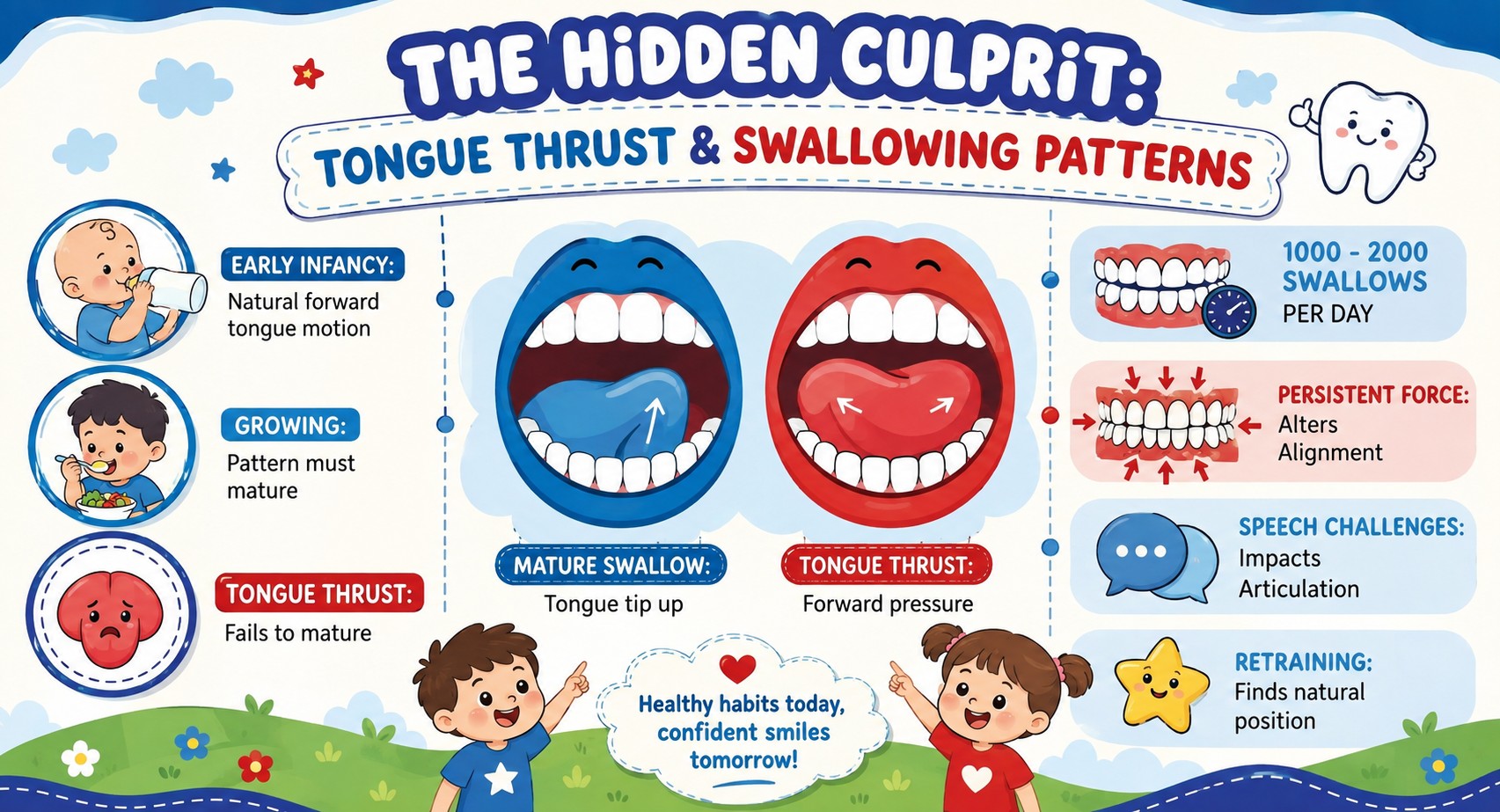
One of the most frequent reasons behind persistent articulation challenges is a condition known as tongue thrust, or an immature swallow pattern.
During early infancy, a forward pushing motion of the tongue is completely natural and necessary for nursing or bottle feeding. However, as a child grows and transitions to solid foods, the swallowing pattern is meant to mature. In a mature swallow, the tip of the tongue presses firmly up into the spot behind the upper front teeth, and a wave of muscular contraction moves food or liquid backward down the throat.
When a mature swallow pattern fails to develop, the forward thrusting motion continues. Every single day, a person swallows between one thousand and two thousand times. If the tongue exerts several pounds of pressure against or between the teeth with every swallow, that repetitive forward force can gradually alter dental alignment and push the tongue into a habitual forward resting position.
This constant forward movement directly impacts speech. When the tongue’s default impulse is to push outward, keeping it inside the mouth to produce clear, crisp speech sounds requires immense conscious effort. Retraining the swallow through targeted exercises relieves that forward pressure, allowing the tongue to find its natural, comfortable position inside the mouth structure.
The Hidden Culprit
Recognizing the Signs of Orofacial Myofunctional Imbalances
Identifying the need for myofunctional support early can make a substantial difference in long-term communication and health outcomes. Because oral habits develop gradually over time, signs can sometimes be subtle or mistaken for simple behavioral traits.
Key Indicators to Observe
Parents, caregivers, and adults evaluating their own oral health can look out for several key indicators:
- Chronic Mouth Breathing: A tendency to keep the mouth open at rest, during daytime activities, or while sleeping.
- Resting Tongue Placement: The tongue frequently resting low in the mouth or visibly protruding between the lips.
- Difficulty Chewing with Lips Closed: Messy eating habits or frequent loud chewing, often caused by an inability to comfortable seal the lips while moving food around the mouth.
- Persistent Speech Sound Distortions: Ongoing difficulty pronouncing specific sounds despite traditional speech support.
- Restless Sleep or Snoring: Waking up frequently, tossing and turning, or breathing heavily at night due to compromised upper airway space.
- Dental Issues: Open bites, where the front upper and lower teeth do not meet when the jaw is closed, or recurring relapse after orthodontic treatment.
When these signs appear in combination, addressing the underlying muscular structure often unlocks progress that had previously stalled.
How Myofunctional Therapy Enhances Comprehensive Speech Care
It is important to view myofunctional therapy not as a replacement for traditional speech therapy, but as a powerful, complementary partner. While traditional speech intervention focuses directly on sound production, phonological awareness, and language development, myofunctional therapy addresses the physical anatomy and muscle tone that make those speech mechanics possible.
Imagine trying to play a high-precision sport on a field that is uneven and overgrown. You can practice your technique endlessly, but the physical environment presents a constant obstacle. Myofunctional therapy levels the playing field. By strengthening the mouth muscles, encouraging proper resting posture, and promoting nasal breathing, it creates the ideal physical foundation for speech work to take hold quickly and permanently.
A Holistic, Interdisciplinary Approach
Comprehensive care often involves a collaborative team working together to address every facet of a person’s oral health and communication:
- Myofunctional Therapists and Speech Specialists: Focus on muscle retraining, resting posture, tongue mobility, and functional sound placement.
- Dentists and Orthodontists: Ensure the dental arches and palate are wide enough to accommodate the tongue comfortably, addressing structural narrowness that might restrict movement.
- Ear, Nose, and Throat Specialists: Evaluate airway health to ensure the nasal passages are completely clear, making persistent nasal breathing physically achievable.
This holistic perspective ensures that physical obstacles, functional habits, and communication goals are tackled simultaneously, leading to far more reliable and lasting results.
What to Expect During the Therapeutic Process
Embarking on a myofunctional program is a structured, empowering experience designed to build lasting muscle memory. The journey typically follows several deliberate phases, tailored carefully to each individual’s unique anatomical needs and personal goals.
Comprehensive Assessment
The process begins with an in-depth evaluation. The practitioner carefully examines:
- Facial symmetry and resting lip seal
- Tongue mobility and range of motion, checking for physical restrictions like a tight tissue band under the tongue
- Swallowing mechanics with solids and liquids
- Breathing patterns during rest and active tasks
- Specific speech sound errors and overall vocal clarity
Customized Exercise Programs
Once baseline patterns are established, a personalized program is designed. Myofunctional exercises are simple, highly targeted movements that require consistency and focus. Rather than long, exhausting sessions, the therapy relies on short, frequent practice routines completed daily at home.
Exercises often target specific functional areas:
- Tongue Tone and Mobility: Lifting exercises that build strength in the tip, body, and back of the tongue, encouraging it to suction comfortably to the roof of the mouth.
- Lip Seal and Tone: Muscle conditioning to help the lips rest together effortlessly without straining the chin muscles.
- Jaw Stability: Building independence so the tongue can move fluidly without relying on the jaw to slide or shift to complete a sound.
- Airway and Breathing: Retraining breathing habits to prioritize steady, calm nasal airflow throughout the day and night.
Over time, these intentional exercises transform into automatic subconscious habits. As the correct resting posture becomes second nature, the physical effort required to speak clearly decreases significantly.
Tailoring Intervention Across Different Age Groups
The benefits of myofunctional support extend across every stage of life, though the focus and implementation strategies naturally adapt to suit the individual’s developmental phase.
| Age Group | Primary Focus Areas | Typical Therapeutic Goals |
| Young Children | Gentle habit redirection, play-based muscle activation, airway awareness | Establishing open nasal passages, stopping thumb sucking or prolonged pacifier use, encouraging closed-lip resting posture |
| School-Age Children | Targeted muscle strengthening, tongue elevation, articulation support | Eliminating tongue thrust swallows, correcting frontal or lateral lisps, supporting ongoing orthodontic work |
| Teens & Adults | Conscious habit retraining, muscle tone recovery, long-term posture alignment | Resolving long-standing speech distortions, relieving facial muscle tension, supporting sleep health and overall jaw comfort |
In younger individuals, early intervention takes advantage of natural growth spurts, guiding facial development in a balanced direction. For adults, therapy offers a way to retrain long-established patterns, providing relief from chronic oral compensations and helping clear up persistent articulation errors that may have felt permanent for years.
Broader Health Benefits Beyond Clear Speech
While improved speech clarity and articulation are often the primary reasons families seek out myofunctional therapy, the benefits of establishing correct oral mechanics extend well beyond clear communication.
Enhanced Airway and Breathing Quality
Breathing through the nose is fundamental to overall wellness. The nasal passages act as a natural filtration and humidification system, warming incoming air, trapping allergens, and introducing beneficial nitric oxide into the bloodstream to aid oxygen absorption.
When myofunctional therapy restores a closed-lip resting posture and elevates the tongue to the roof of the mouth, it helps clear the upper airway. This shift often leads to deeper, more restorative sleep, reduced snoring, and better daytime energy and focus.
Long-Term Dental and Facial Stability
The position of the tongue plays a surprisingly dominant role in shaping the mouth structure. When the tongue rests against the palate, it acts as a natural internal expander, encouraging the upper jaw to grow wide and rounded. This creates ample space for adult teeth to emerge straight and aligned.
For individuals undergoing orthodontic care, integrating myofunctional therapy ensures that muscle habits work with the braces or aligners rather than pushing against them. Once orthodontic appliances are removed, maintaining proper tongue resting posture prevents teeth from shifting back toward old positions.
Comfortable Eating and Digestion
A mature, efficient swallow pattern improves the mechanical breakdown of food in the mouth. When chewing and swallowing happen smoothly with closed lips, eating becomes far more comfortable and efficient, reducing swallowed air that can cause digestive discomfort.
Embracing a Path Toward Confident Communication
Clear speech is far more than just a mechanical skill; it is a vital part of how we share our thoughts, express our personalities, and connect with the world around us. When muscle imbalances or improper resting habits create barriers to effortless articulation, it can impact confidence in social, academic, and professional environments.
Myofunctional therapy provides a grounded, natural pathway to overcoming these obstacles. By addressing root physical habits and building strong, coordinated muscle memory, it gives individuals the physical foundation they need to speak with ease and clarity.
At ABLE UK, we believe in taking a thoughtful, holistic approach to every individual’s unique communication journey. By assessing the complete picture, from muscle function and airway health to sound production and personal confidence, we help families navigate the path toward clear speech and lasting well-being. Recognizing the subtle physical details behind speech mechanics opens up exciting new possibilities for growth, healing, and articulate expression.
