
Top Occupational Therapy Techniques for Children with Autism

Top Occupational Therapy Techniques for Children with Autism
For a child, their world is made up of daily activities: playing, learning, getting dressed, and eating. These aren’t just routines; they’re their “occupations.” But for a child on the autism spectrum, these simple tasks can often feel overwhelming, like a puzzle with missing pieces. An occupational therapist (OT) is a skilled professional who works to fill in those gaps, helping children build the necessary skills to navigate their world more confidently and independently. This isn’t about teaching them a job, but about empowering them to master the “work” of being a kid. The techniques used are not one-size-fits-all; they are carefully chosen and tailored to each child’s specific needs, strengths, and challenges. The goal is never to “fix” the child, but to equip them with the tools and strategies to navigate their world more successfully and feel a greater sense of calm and competence.
Understanding Sensory Integration and Why It Matters
One of the most foundational and widely-used occupational therapy techniques for children with autism is Sensory Integration Therapy. To understand why this is so important, we first have to understand that many children on the spectrum experience the world in a way that is either too intense or not intense enough. Their brain might have trouble processing information from their senses—sight, sound, touch, smell, taste, and the lesser-known senses of body position (proprioception) and movement (vestibular).
Imagine walking into a room where all the lights are flickering, a dozen different songs are playing at once, and the texture of the floor feels like sandpaper on your feet. You’d feel overwhelmed, anxious, and unable to focus. For a child with sensory processing challenges, this is what an ordinary classroom or a family dinner might feel like.
Sensory integration therapy is a targeted approach designed to help a child’s nervous system process and organize sensory input more effectively. An occupational therapist trained in this area creates a “sensory diet” for the child—a personalized plan of sensory activities that they can do throughout the day to help regulate their system. These activities are designed to be fun and engaging, but they are also highly strategic.
- Heavy Work and Proprioceptive Input: Many children on the spectrum seek or need “heavy work” activities. These are tasks that involve pushing or pulling against resistance, which provides deep pressure to the joints and muscles. This input helps a child feel more grounded and in control of their body. Activities might include pushing a heavy box, carrying groceries, jumping on a trampoline, or even squeezing a stress ball. A therapist might have a child do a series of “wheelbarrow walks” or army crawls to get them ready for a focused task.
- Vestibular Input for Balance and Movement: The vestibular system is our internal sense of balance and movement, located in the inner ear. Children who are either very sensitive to movement or constantly seeking it can benefit from activities like swinging, spinning on a swing set, rocking in a rocking chair, or sliding down a slide. A therapist will carefully monitor how a child responds to these movements to help them become more comfortable and regulated.
- Tactile Input and Tolerance: For children who are sensitive to touch, an OT might use tactile activities to help them become more tolerant of different textures. This could be as simple as playing in a tub of rice, sand, or beans, or as complex as a “sensory bin” filled with different objects to find. The goal is to gradually expose the child to different textures in a non-threatening, playful way.
By providing these regulated sensory experiences, the therapist helps the child’s brain “wire” itself to process sensory information more efficiently. This often leads to a decrease in meltdowns, an improvement in attention and focus, and a greater sense of calm.
Mastering Fine and Gross Motor Skills
Another key area for occupational therapy is developing a child’s motor skills. These are the skills needed for movement, and they are divided into two main categories: gross motor and fine motor.
- Gross Motor Skills: These are the large movements of the body. They include running, jumping, climbing, and throwing a ball. Some children with autism may have difficulty with coordination or balance, which can affect their ability to play sports or engage in playground activities with their peers. An OT might use obstacle courses, balance beams, or climbing equipment to help a child improve their coordination, planning, and body awareness.
- Fine Motor Skills: These are the small, precise movements of the hands and fingers. They are essential for tasks like writing, buttoning a shirt, using utensils to eat, or tying shoelaces. An occupational therapist uses creative, play-based activities to strengthen the muscles in a child’s hands. This could involve using tongs to pick up small objects, playing with play-doh, or working on a puzzle. The goal is not just to teach the skill, but to make it a natural, automatic part of their daily life.
The Art of Play-Based Therapy
You might see a child in an occupational therapy session and think they’re just playing. But for an OT, play is a powerful and intentional tool. Play-based therapy is an effective way to help a child with autism learn new skills and practice them in a natural, low-stress environment. It’s an approach that respects a child’s developmental level and interests.
Through play, a child can work on a vast range of skills. For example, during a pretend cooking session, an OT might help a child practice following multi-step directions, using fine motor skills to stir and pour, and even engage in reciprocal play by sharing imaginary food. The therapy is so much more effective because the child is motivated and having fun, and they are learning new skills without even realizing it. The therapist subtly guides the play to create opportunities for skill development.
Social Skills and Peer Interaction
Navigating social situations can be one of the toughest challenges for a child on the autism spectrum. They may struggle with understanding social cues, taking turns in a conversation, or interpreting body language. Occupational therapists often incorporate social skills training into their sessions, using a variety of creative techniques to help children learn these vital skills.
- Structured Group Therapy: Some OTs run small group sessions with a few children. These sessions provide a safe and controlled environment for kids to practice social interactions, like taking turns, sharing, and engaging in cooperative play. The therapist acts as a facilitator, providing real-time coaching and feedback.
- Role-Playing: Therapists often use role-playing to help a child practice navigating common social situations, like asking a friend to play or responding to a bully. This allows the child to practice in a supportive environment before they face the situation in the real world.
- Visual Supports: Many children with autism are visual learners. An occupational therapist might use visual aids, like emotion cards or social stories, to help a child understand different social situations. A social story, for example, is a short story that breaks down a social situation into simple, sequential steps, helping the child understand what to expect and how to respond appropriately.
Building Independence with Visual Supports and Routines
For many children with autism, predictability and routine are essential for feeling safe and calm. Occupational therapists are experts at creating visual supports and structured routines that can make a world of difference in a child’s life.
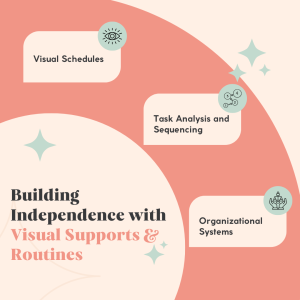
Building Independence with Visual Supports & Routines- Able UK
- Visual Schedules: A visual schedule is a series of pictures or icons that represents a child’s day, from getting dressed to eating breakfast to going to school. Having a clear visual map of their day reduces anxiety and helps a child transition from one activity to the next more smoothly. This is especially helpful for children who struggle with verbal instructions.
- Task Analysis and Sequencing: An OT might break down a complex task, like brushing teeth or getting ready for bed, into a series of small, manageable steps. By teaching a child to complete each step one at a time, they can learn to master skills that once seemed overwhelming. This builds a sense of independence and accomplishment.
- Organizational Systems: For a child who struggles with executive functioning, an OT can help create organizational systems for their belongings, their schoolwork, or their toys. This could be as simple as using labeled bins or color-coded folders. A well-organized environment can significantly reduce a child’s stress and make it easier for them to find what they need.
The Role of Collaboration with Parents and Caregivers
Perhaps the most important aspect of occupational therapy is that it doesn’t just happen in a clinic. An effective OT program is a partnership between the therapist, the child, and the family. Occupational therapists spend a great deal of time coaching parents and caregivers on how to incorporate therapeutic techniques into daily life.
The therapist can teach a parent how to use a “sensory diet” at home, what types of games to play to strengthen fine motor skills, or how to create a visual schedule for a smoother morning routine. This collaborative approach ensures that the skills a child learns in therapy are reinforced and generalized across all of their environments. A parent becomes a co-therapist, equipped with the knowledge and tools to support their child’s development every single day.
Ultimately, the goal of occupational therapy for children with autism is to empower them to be themselves, to build on their unique strengths, and to find confidence in their ability to participate in the world. It’s a field that recognizes the beauty in every person’s unique journey, and provides the vital support needed to help that journey be as successful, joyful, and independent as possible.
